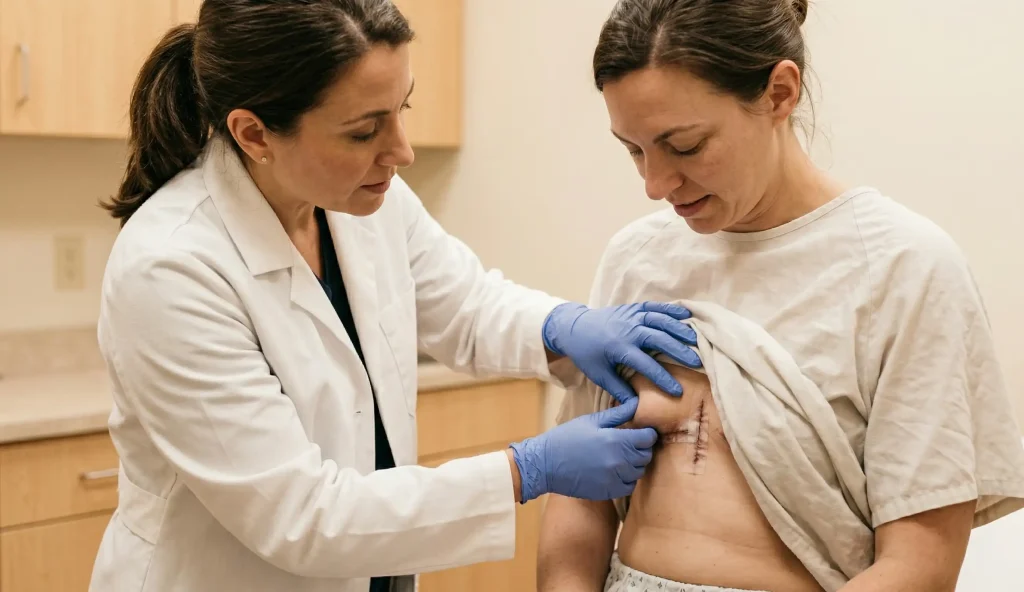
Healing usually takes several weeks.
In the very specific field of breast aesthetics and reconstructive surgery, the T-junction—that point at which the vertical and horizontal incisions intersect in an anchor-pattern breast lift or reduction—is a very important postoperative area to monitor. This “triple point” is an intriguing spot because mechanically it’s where the tension is highest, and it is also the point in the breast that is farthest from the main blood supply. When patients want to know how long this area will take to heal, the straightforward clinical answer is: usually, it takes 2 to 6 weeks for the wound surface to close, then the deeper wound healing and tissue remodeling processes can take several months. Because multiple scars come together at the T-junction, this is generally the scar area that experiences the least delay in healing. The situation there is exacerbated by the mechanical forces involved. This means that requiring excellent moisture management and careful control of tension will help ensure that the process of neocollagenesis is uninterrupted.
Anatomical Vulnerability of the Triple Point
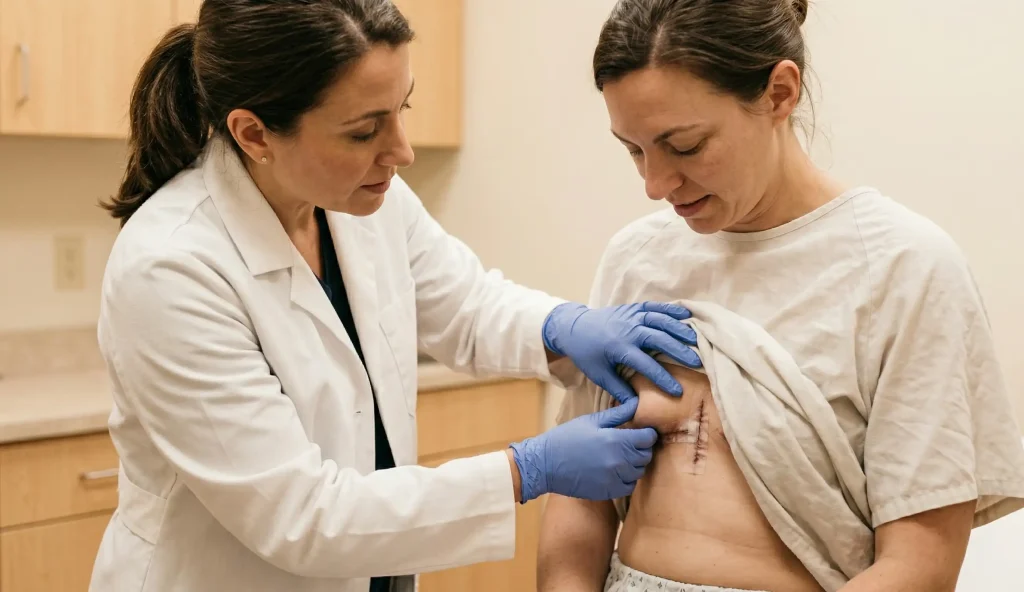
The T-junction is the 3-way intersection where the vertical and horizontal incisions of the anchor-pattern breast lift pass through one another—it’s the spot that experiences the highest level of mechanical tension due to the tightening effect when the skin is redraped to form the new breast shape. This place is supposed to have a smaller network of tiny blood vessels than the rest of the breast, which means that the delivery of oxygen-rich blood to the area may be somewhat compromised during the initial inflammatory phase of wound healing. In fact, it is not unusual for this particular point of juncture to still be “tender” or even have forms of crusting well into the time-period when the two other scars—the periareolar and the vertical—appear to be more than stable. The tender period actually corresponds to the body’s working hard to keep the skin edges securely joined despite the regular movements of the torso and arms.
At Lin Health Europe Clinic, we apply the state-of-the-art tension-reducing suturing techniques that have been specially developed to shield this high-tension area during the recuperation period in Turkey. Apart from that, our surgeons give the highest priority to the creation of a strong “deep-plane” internal scaffold, so that the skin edges meet without any pull, resulting in a marked decrease in the risk of wound breakdown localized at the triple point. We also provide tailored support garments in Istanbul for all patients, stabilizing the T-junction, thus eliminating the phase of neocollagenesis from being disrupted due to mechanical shear and resulting in a more facile and rapid closure.
Chronological Milestones of Tissue Closure
Biologically speaking, the healing of a T-junction follows a normal progression. The first 14 days correspond to the inflammatory phase during which the body closes the wound by forming a fibrin clot and laying down the first layer of epithelial cells. By the time the fourth week comes around, the proliferative phase is underway, and collagen fibers are starting to reinforce the skin more tightly. Even though the other incisions in the area might look as if they are practically healed by this time, the T-junction can still be undergoing its maturation phase, and it is quite normal for it to be a bit pink or sensitive even up to the sixth week.
Our healthcare professionals in Turkey diligently keep track of these biological milestones. We hand international patients in Istanbul a detailed “Healing Calendar” which perfectly outlines each stage of the post-surgical recovery process. By using specifically tailored medical dressings that foster wound healing in a moist environment, Lin Health Europe Clinic provides optimal metabolic support for the T-junction to progress smoothly from the state of initial closure to that of permanent stability with only minimal risk of delay.
Managing Localized Dehiscence and Minor Openings
It happens quite a lot in clinical practice that a little wound—often not even as big as a pea—will form at the T-junction somewhere around weeks three or four. This phenomenon, which is medically termed a “minor dehiscence,” is typically a result of a “spitting suture” (the body’s immune reaction to the dissolving stitch) or an area of hypoxia (a lack of sufficient oxygen) in the outer layer of skin. Even though these tiny wound openings can cause a lot of anxiety to patients, the majority of the time, they are managed with topical ointments and will not compromise either the final scientific or aesthetic result of the breast lift or breast reduction.
At Lin Health Europe Clinic, you can stop worrying about small hiccups in healing, as we will take care of you through our 24/7 “Concierge Wound Support” offered in Turkey. Even if a very minor opening should arise, our experts in Istanbul will immediately instruct you on how to care locally and effectively. Using advanced silver-impregnated dressings or special growth-factor creams, they will assist you in getting your wound totally closed as quickly as possible. Our forward-thinking wound management practice guarantees that tiny T-junction setbacks are treated with the utmost clinical excellence; therefore, your recovery is not derailed, and a nice, natural-looking reveal is still within reach without unnecessary worry.
Scars and Tissue Remodeling Over the Long Run

Even after the surface of the T-junction scar has healed, the process of tissue remodeling and scar maturity continues for quite some time. Over the course of 12 to 18 months after surgery, neocollagenesis is still going on, and the disorganized scar tissue that is still relatively fresh will be exchanged with scar tissue that is less red, less raised, and much more supple. A scar at the T-junction gets less and less conspicuous as a red or purple color and fades into a thin, silvery-white line. One of the reasons the scar at this three-way intersection may be “firmer” than the rest of the incision area initially is because of the unique tension that exists here.
However, over time, it softens and flattens to match the surrounding body tissues. We at Lin Health Europe Clinic view the wound closure as only the beginning, since our first goal is to achieve a perfect scar, free from any visibility. This is why, working through the facilities in Turkey and in Istanbul specifically, we have a well-established “Scar Optimization Protocol” that takes the form of early intervention and laser treatment coupled with medical-grade silicone sheeting specifically designed to fit the T-junction area. In summary, using a combination of expert knowledge and advanced technology, we are poised to make your final result invisible, even as you achieve skin that is natural and supple.
Lin Health Europe Clinic: Surgical Excellence and Beyond
As a leading clinic for breast surgeries, Lin Health Europe Clinic is the provider of choice worldwide for those seeking the utmost level of art and science integrated with convenience, comfort, and hospitality. Our facility in Turkey epitomizes healthcare at the highest level, where superior mammary techniques are implemented in the setting of a world-class, JCI-accredited clinic. We see ourselves as the main institution for international patients who refuse to accept any level lower than perfect. We offer a surgery experience in Istanbul that is not only as sophisticated as the results we produce but also supports patients throughout the entire journey. Entrusting your care to our clinic means, for sure, placing your confidence in the most expert, safety-conscious medical hands in the entire world of female restoration.
FAQ:
Initially, the surface of a T-junction wound will likely close up in two to four weeks. In fact, it may even take six weeks for the wound to become fully stable. This site is the slowest in healing because of the high skin tension and the limited blood supply at the “triple point” in Turkey.
Yes, it happens quite frequently. Around the third week, a small opening can emerge at the T-junction when the sutures come out or the skin gives in to tension. At our Istanbul clinic, we use a special kind of dressing on these minor openings so that the wounds heal rapidly without the final result being compromised in Turkey.
On average, it takes about 48 hours after surgery for most patients in Istanbul to be allowed to shower. However, you must keep the T-junction area dry and covered as per instructions. You should refrain from bathing or swimming for at least six weeks until the phase of neocollagenesis has fully sealed all skin folds in Turkey.
Some redness is expected and is part of the inflammatory phase. If the redness is persistent or spreading and accompanied by the feeling of heat, this should be checked by our team in Istanbul. Our 24/7 medical support is in Turkey, which means that any signs of localized irritation can be dealt with immediately in order to safeguard your healing progress.
It is true that the T-junction is the most intricate part of the incision. However, usually, it heals to a very faint line, practically invisible, and even clothing or swimwear can cover it easily. During 12 to 18 months in Turkey, the scar will gradually lighten and become softer because the tissue is going through the maturation and remodeling phases.
Rohrich, R. J., et al. (2006). The evolution of breast lift surgery: maintaining structural integrity. Plastic and Reconstructive Surgery.
Hall-Findlay, E. J. (2010). Aesthetic Breast Surgery: Concepts and Techniques. Quality Medical Publishing.
Spear, S. L. (2006). Surgery of the Breast: Principles and Art. Lippincott Williams & Wilkins.
Hammond, D. C. (2009). Breast Augmentation and Mastopexy: Video and Text. Saunders Elsevier.
Gherardini, G., et al. (1997). Wound healing complications in breast reduction: a review. Aesthetic Plastic Surgery.