
Best done several months before summer.
In the specialized field of high-definition body contouring and abdominal reconstruction, scheduling a tummy tuck (abdominoplasty) is the major deciding factor in obtaining the greatest summer aesthetic results. Patients seeking the right timeframe to have surgery in order to generate the “summer body” effect are essentially being explained the biological window of tissue maturation and edema resolution by the professionals. Although the surgical change is largely instantaneous, the body’s internal tissues need substantial time for neocollagenesis—the re-stitching of tissues—to reach a state of permanence, flatness, and natural appearance. Hence, to be fully “beach-ready” which includes wearing a swimsuit without any hassle and doing other outdoor things, it is highly recommended that a patient plans their procedure 4 to 6 months before the summer target date.
The 6-Month “Golden Window”: Winter and Early Spring
The best moment for a tummy tuck to be revealed in the summer is the late fall or winter (November – February). This “Golden Window” allows your body 180 days for internal tissues to undergo full stabilization. Choosing to have a winter surgery in Turkey means you take advantage of the coldest months to handle the “compression phase.” During cold weather, it is much less irritating to wear a pressure Faja (compression garment) and also, it can be hidden easily under the winter clothes.
At Lin Health Europe Clinic in Istanbul, we tell our foreign visitors that by the time June comes, the inside progress of neocollagenesis will have resulted in an abdomen that is not only quite strong but also the residual swelling will be 95% gone and what had been the “tightness” of muscles will now be a natural, flexible feeling.
Dealing with Postoperative Edema: The “3-Month” Mark

One of the typical side effects after a tummy tuck is swollen tissues that seem to come and go. Just after the drains have been taken out, patients still complain of the abdomen swelling on an irregular basis, especially quite late and after doing some exercise. This phenomenon is greatest in the first 6 weeks and by the third month, it is almost gone. So if you decide to have surgery in Turkey in April or May, you will most probably have to suffer from the significant “evening bloat” at the height of summer. One of the main foci of our expertise includes the implementation of a “swelling-reduction” treatment.
Here in Istanbul, the general consensus among patients is that those who plan and allow themselves a full four months before surgery are way more pleased with the “beachside pictures” when the skin of the abdomen has been able to have time to adhere firmly to the muscle, giving that crisp, high-definition look that only a successful abdominoplasty defines really well.
Scar Maturation and UV Protection
The horizontal scar is probably the most significant long-term consequence of a tummy tuck. During its initial 3 to 6 months, a scar goes through a “vascular” stage which displays it as red or purple. If a fresh scar gets exposed to the intense UV rays of the Turkish or Mediterranean sun, it might lead to permanent hyperpigmentation, resulting in a darker and more visible scar for the rest of one’s life.
Choosing winter surgery at Lin Health Europe Clinic means that your scar will be in the “fading” stage by the time summer comes around. Moreover, a 6-month period means that your wound will be stable enough to wear high-SPF sunscreen and swimwear safely without getting irritated or physically “stretched” by the saltwater or chlorine present in Istanbul.
Going Back to the Gym: Getting the “Toned” Appearance
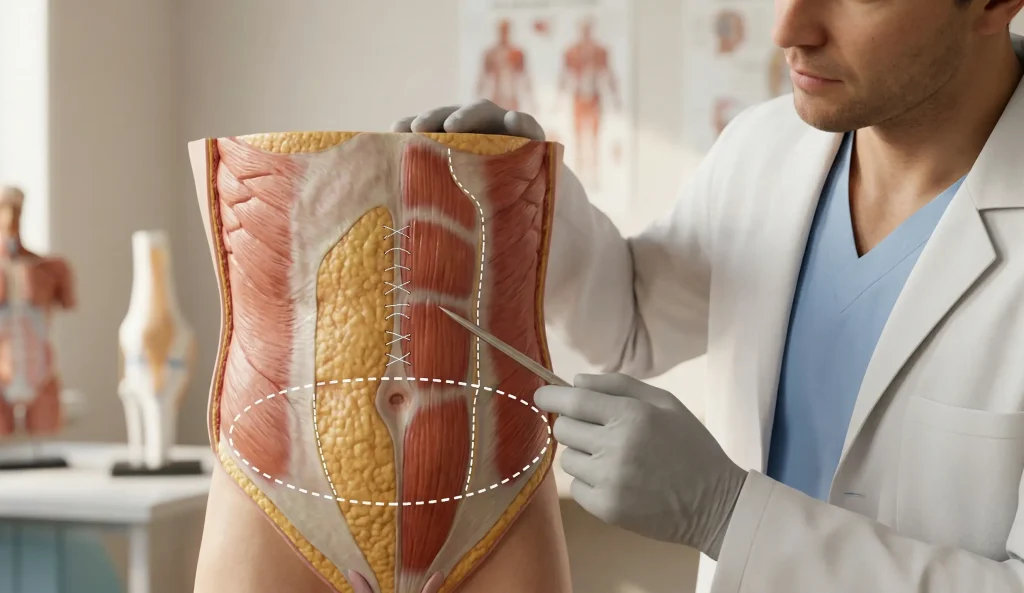
In terms of a “summer body,” it is not only about getting rid of the extra skin but also about the outline of the muscles beneath the surface. Even though a tummy tuck can mend the rectus diastasis (split muscles), you still need time before you can get back to those core exercises that reveal the final “definition” take.
- Weeks 1–6: Heavy lifting and core engagement are not allowed in Turkey.
- Weeks 8–12: One can slowly get back to light cardio and resistance training.
- Month 4+: Usually, one’s entire “beach body” workout, including high-intensity core training, is given a green light.
Our medical personnel in Istanbul stress the point that having surgery during winter, one is afforded the whole spring season to safely “tone up.”
The “Comfort Factor” of International Travel
If you are an international traveler, there are plenty of practical reasons to go for a winter or early spring medical trip to Turkey. Besides worsening swelling and a higher chance of dehydration, traveling and healing in the heat of the Turkish summer is generally quite uncomfortable.
In Istanbul, the “off-season” has less extreme temperatures, allowing you to have your initial post-surgical walks quite comfortably. Plus, our clinic in Turkey during these months is able to offer a more flexible scheduling structure which gives you the opportunity to pick the dates most suitable to your work and life situation. We also understand that having an environment free of stress during recovery is as important as the surgery itself. Planning your transformation ahead of time will ensure it is a private and well-managed process that becomes publicly visible as a confident new you basking in the first summer sun.
Tummy Tuck in Turkey
At Lin Health Europe Clinic, we consider that a successful outcome is one that comes from careful and thorough preparation. We are fortunate to be located in Turkey – a place where the science of body contouring has advanced greatly on an almost weekly basis and at the same time, our highest global patient care standards are mirrored in our award-winning hospitals and the JCI accreditation.
Choosing Lin Health Europe Clinic means selecting the most talented and safety-conscious hands in Istanbul. Our specialists have international reputations and their top priority is to harmonize your aesthetics and structural integrity in the long run for every patient who visits us from abroad. You will witness the perfect blend of professional thoroughness and luxurious hospitality that has made us the leading brand in aesthetic medicine, right from your first biometric assessment till the day you show off your new figure on the beach. When it comes to a perfectly reconstructed and summer-ready abdominal area, you will be in the best hands with us.
FAQ:
The best time, really, would be to have the procedure done during the winter months (November to February) so you can have up to 4 to 6 months of recovery when most of the swelling goes down. If you book your operation in Istanbul towards the beginning of the year, by the time summer gets here in Turkey, you’ll be all healed up and ready to rock a swimwear.
Usually, one could be able to go to the beach around 8 to 12 weeks after surgical intervention, assuming that the person refrains from swimming in salt water until the wounds are fully healed. At our Istanbul practice, we can provide sun-blocking products and advice for keeping your scars out of the sun, as exposure to UV rays causes scars to darken permanently and scars that are visibly dark stand in contrast to the typical scar appearance that is aesthetically pleasing.
Right after the surgery, you are allowed to do a little bit of walking, but heavy-exercise, walking-ups and core-exercise are not allowed for at least 8 to 12 weeks. Slowly getting back your regular gym-routine in Istanbul is a good move as it ensures that the internal repairs of the muscles and neocollagenesis are not disturbed during your recovery phase.
The surgeon makes the incision in a very low position on the belly so that it can be easily concealed under a typical bikini bottom or underwear line.
It is expected that the patient will feel a localized “tightness” and muscle soreness which is analogous to the feeling after a very intense workout, but in reality, most patients think that the pain can be controlled with the help of the prescription medication that is provided.
Matarasso, A. (1989). Abdominolipoplasty: a system of classification and treatment for combined abdominoplasty. Aesthetic Plastic Surgery.
Pollack, H., & Pollack, T. (2000). Progressive tension sutures: a technique to reduce local complications in abdominoplasty. Plastic and Reconstructive Surgery.
Nahas, F. X. (2001). An aesthetic classification of the abdomen based on the myoaponeurotic layer. Plastic and Reconstructive Surgery.
Swanson, E. (2015). A prospective study of 100 consecutive abdominoplasties, emphasizing patient satisfaction and recovery. Plastic and Reconstructive Surgery.
Di Pietro, V., et al. (2014). Management of postoperative edema after abdominoplasty. Journal of Plastic, Reconstructive & Aesthetic Surgery.