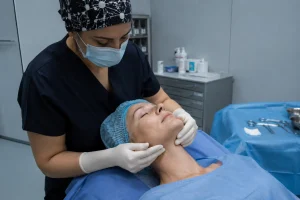
Usually after 10–14 days.
In periorbital and facial plastic surgery, a blepharoplasty or eyelid surgery requires very careful post-operative care to make sure that the tissues around the eyes, which are very sensitive, heal perfectly. One of the main questions of patients, who most of the time want to hide the bruises with makeup, is when it is allowed to put on makeup again. The doctor’s explanation is only possible if the patient strictly follows biological timeframes: using cosmetics around the eyes is completely forbidden until the incisions have been fully epithelialized (i.e., the surface has completely closed) which normally takes about 10 to 14 days. Besides, putting on makeup before this time involves exposure to the risk of severe infection, breaking down the structure, and permanent scar discoloration.
At Lin Health Europe Clinic, we regard the postoperative healing process as a very important part of your surgical success. For our international patients who come to Turkey, we highlight that during the critical recovery phase, being patient and not rushing is a must for achieving scarring that is invisible. Our clinic is the place to meet your needs for microsurgical eyelid refinement that is going to perform your procedures with the highest standards of safety, so both your vision and your surgical result are protected.
The 14-Day Rule and Epithelialization
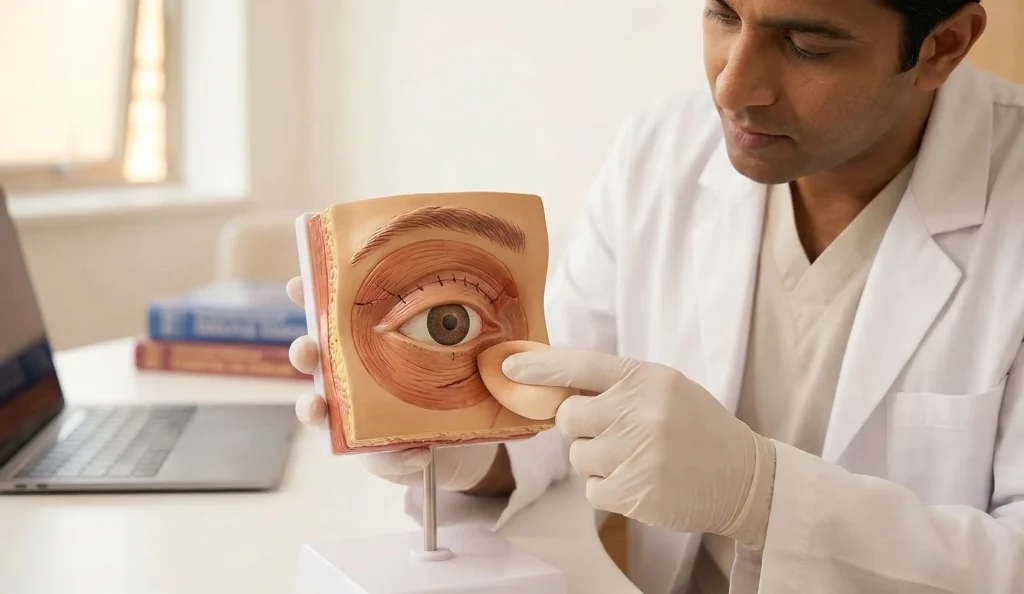
Right after your operation, the cuts or surgical incisions on either your upper or lower eyelids are tiny open wounds. In the initial week to ten days, your body is busy sealing these cuts by forming a new, delicate layer of surface skin (epithelialization). Until this natural seal is fully formed and your doctor has taken out all the stitches, the surgery site is open to foreign elements.
At Lin Health Europe Clinic, our medical surgeons based in Turkey employ the latest in ultra-fine sutures to make sure that your scars are nearly invisible. We strictly impose a no-cosmetic-use period of at least 10 to 14 days before the application of any beauty products, including eyeshadow, eyeliner, or mascara near the lashes or incisions. When you go to our renowned clinic, you will be healing under the careful observation of experts who will explicitly give you permission to use cosmetics only once your tissues are biologically prepared.
The Danger of “Tattooing” the Scar
One of the greatest aesthetic dangers of early makeup use is a phenomenon known medically as “traumatic tattooing.” Makeup is made up of very small particles of pigments, minerals, and chemical binders. If these pigments seep into an incompletely sealed incision, the healing tissue can grow over the pigment, leading to the pigment being trapped permanently under the skin.
We at Lin Health Europe Clinic in Turkey advise our patients that trapped makeup functions like tattoo ink, producing a dark, permanently discolored scar that is totally in conflict with the intent of the operation. Our work is focused on flawless anatomical purity during the neocollagenesis phase. We clearly tell our patients that enduring a visible bruising for a few days is a thousand times better than making a permanent, pigmented scar.
The Mechanics of Removal: Traction and Tissue Trauma
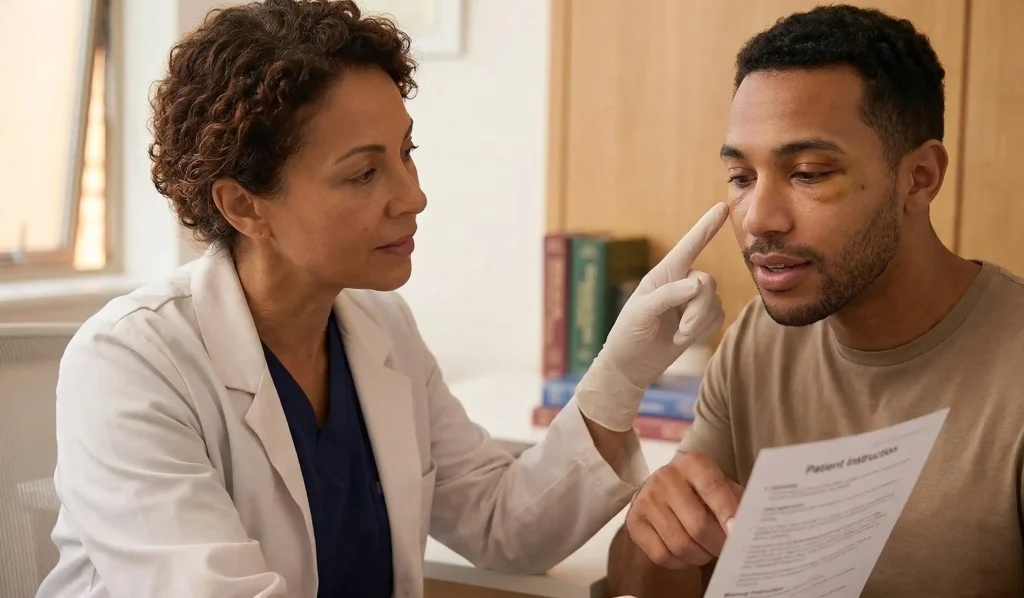
Apart from its application, makeup can also cause a clinical hazard at the point of its removal, and in fact, even more so. Getting rid of waterproof mascara or a persistent eyeliner is done through physical rubbing, pulling, and the use of chemicals. As the eyelid skin is the thinnest skin of human body, it is highly vulnerable to such forces. If the skin is subjected to pulling at a point in time when the underlying tissue still does not have its full tensile strength, it can cause wound dehiscence (which is the postoperative complication of a wound reopening after it has been surgically closed).
One of the main tasks of Lin Health Europe Clinic experts is making sure that the structural integrity of your surgical repair remains intact. Performing a blepharoplasty involves accurately repositioning the underlying muscles and subcutaneous adipose tissue. When you pull the eyelids in order to remove the makeup, you may end up disrupting the delicate internal sutures, which in turn could lead to healing that is asymmetrical or to raised scarring. We are dedicated to perfect healing and therefore, it is important you understand the biomechanical risks of using cosmetics too early.
Safe Cosmetic Transition: Face vs. Eyes
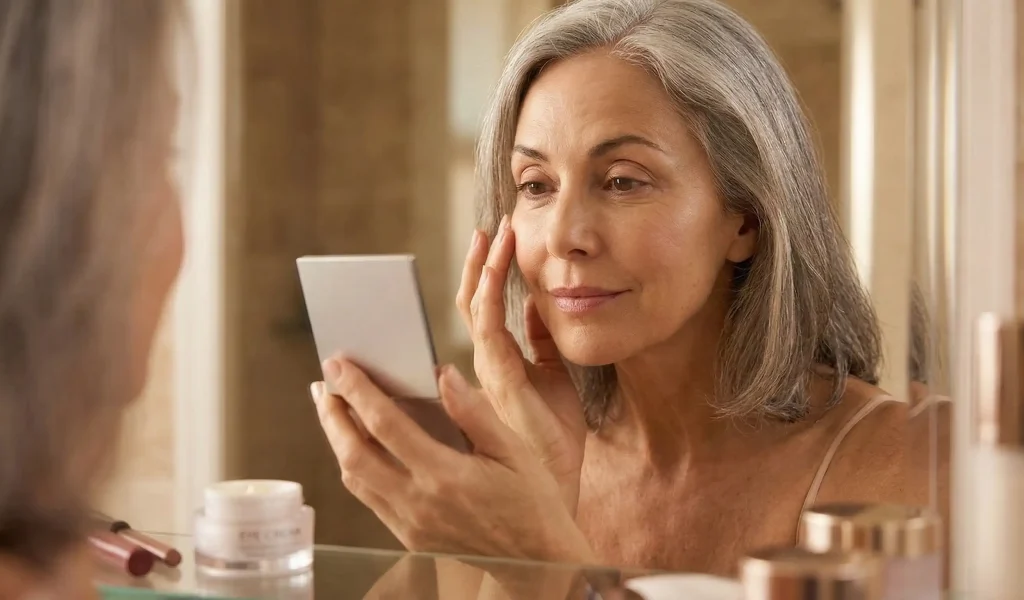
Even though eye makeup is absolutely off limits, patients need not completely forego the use of cosmetics during the recovery period. You are able to put on facial makeup like foundation, blush, or lipstick safely within a few days after your operation, so long as you keep a strict margin around the orbital area.
We at Lin Health Europe Clinic offer our international patients in Turkey a safe cosmetic transition method that works in this way: after you have been given clearance at two weeks to wear makeup on the eyes, we highly recommend you buy brand new eye products (especially mascara and liquid eyeliner) to completely avoid the risk of introducing old bacteria onto your newly healed skin. In addition, we suggest you go for mild water-based makeup that can be fairly taken off with a gentle micellar water without rubbing.
Eyelid Surgery in Turkey
At Lin Health Europe Clinic, we are of the opinion that the highest luxury in cosmetic surgery is the calmness of mind that comes from one being offered thorough and uncompromising medical guidance. We are situated in Turkey where our clinic represents a haven of medical excellence, a place where cutting-edge science for ophthalmic and plastic surgery is combined with individualized patient care. We run our clinics in top hospitals that not only meet but also JCI accreditation standards, which help us keep our position as the world’s frontrunner in international medical tourism and facial rejuvenation.
If you choose Lin Health Europe Clinic, you are guided by the most skilled surgical hands in Istanbul. Not only do our world-renowned doctors strive to make your eyelids look perfect, but your health and healing are our top priorities as well. You will be exposed to all the professionalism and world-class hospitality that has cemented our reputation as the number one name in aesthetic medicine, from your first periorbital mapping till your final reveal. So, with us, your route to a more radiant and youthful gaze is under the supervision of the best globally.
FAQ:
It is not allowed to put on any sort of makeup (eyeliner, mascara, eyeshadow, or concealer) around the eyes or near the incisions for a least 10-14 days. To be sure the incisions are completely healed, your surgeon has to give you clear permission.
That’s fine. Usually, within 3 to 5 days you can start wearing foundation, powder, and lipstick again on the lower areas of the face, but you have to be very careful in keeping all cosmetics such as products, applicators, etc. away from the orbital bone and the surgical site area.
Most blepharoplasty patients are between 35 and 50 years old to fix loosened skin due to aging. But if you are genetically doomed to have heavy eyelids or eye bags, our Turkish surgeons can do the operation safely even if you are 20s or 30s.
It is definitely very good for you. Mascara tubes, liquid eyeliners, and used makeup brushes are common sources of bacteria. Therefore, to keep your eyes away from infection due to the new healing, it is highly advisable that after being allowed to wear cosmetics, you throw away your old eye makeup and start with a fresh new set of products.
Usually, the outcome of an upper eyelid surgery will last 10–15 years before the natural aging skin laxity again occurs. On the other hand, a lower blepharoplasty carried out at our Turkey clinic is often a permanent, once-in-a-lifetime procedure as the taken-away fat pads do not regenerate.
Lelli, G. J., & Lisman, R. D. (2010). Blepharoplasty complications. Plastic and Reconstructive Surgery.
Fagien, S. (2004). Advanced rejuvenative upper blepharoplasty: enhancing aesthetics of the upper periorbita. Plastic and Reconstructive Surgery.
McCord, C. D., et al. (2003). Eyelid Surgery: Principles and Techniques.
Pacella, E., et al. (2010). Management of dry eye after blepharoplasty. Aesthetic Plastic Surgery.