Unnatural tension or visible scarring.
A rhytidectomy or facelift aims to rejuvenate one’s appearance by restoring youth-like features without revealing the fact that surgery was performed. If a facelift is done with outdated methods or poor biomechanical understanding, it may create unnatural shapes that will be a clear giveaway of surgery. Most times, a “bad facelift” is a result of excessive pulling of the skin to cover up changes when the proper technique involves lifting and repositioning the deep connective tissues and the subcutaneous fat.
At Lin Health Europe Clinic, we see not revealing these “telltale signs” as the basics that must be mastered in order to perform exceptional facial surgeries. For our patients from Turkey who require facelifts, we underscore that after a facelift, you should be able to look at yourself in the mirror and see a deeper restfulness rather than feeling like you look “operated on.” Our clinic is not only frequented by patients for first Deep Plane Facelifts but also for our highly skilled revision surgery that corrects the damage of previous surgeries and restores the invisible and natural harmony of your features. We also offer other plastic surgeries, including breast reduction and gynecomastia surgeries.
The “Wind-Blown” or Pulled Appearance
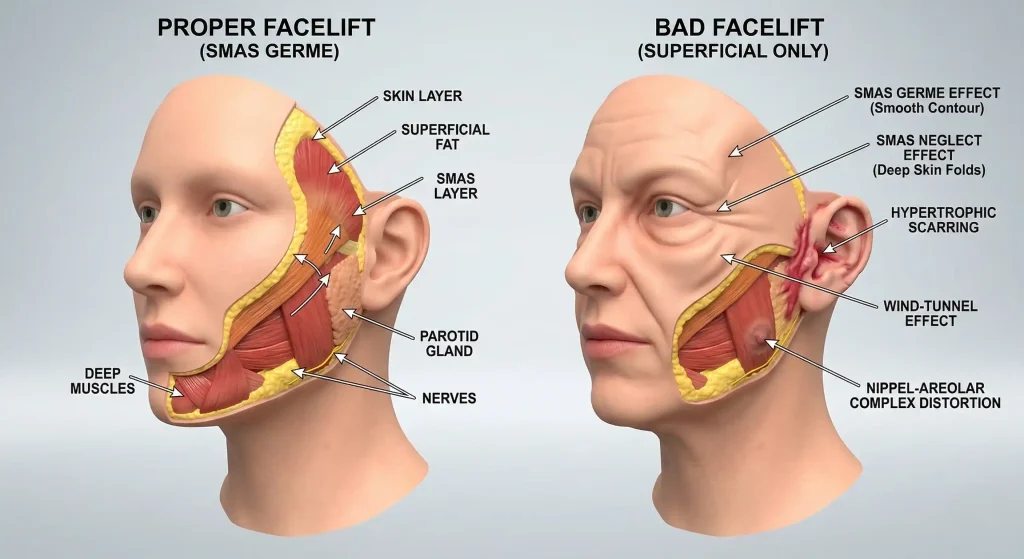
That “wind-blown” or overly tightened look is probably the most well-known sign of a poorly done facelift. From a medical standpoint, it happens when the surgeon only plans to remove facial wrinkling by stretching the skin towards the ears horizontally. Instead, through deep lifting, support is given to the SMAS (Superficial Musculoaponeurotic System) in a direction that opposes gravity.
As skin has very good viscoelastic features, initially, the patient will experience a uniform, tightened face, followed by the inevitable loss of natural facial expressions when the skin stretches. At Lin Health Europe Clinic, our surgeons in Turkey use sophisticated Deep Plane techniques that prevent such a drawback. We concentrate on breaking the firm deep ligaments so that the muscle layer of the face can be raised without tension. In line with our status as the gold standard for natural aesthetic results worldwide, your skin at our prestigious clinic will simply fall over the re-supported structural framework.
The “Pixie Ear” Deformity
The “pixie ear” deformity is a skin mismanagement error that manifests in a major and striking way. When a skin closure is sealed with high tension at the earlobe, the earlobe during the healing phase will be pulled downward, causing loss of its original curve and its stretching to a “V” shape that is attached directly to the jawline.
Our team at Lin Health Europe Clinic in Turkey goes a step further by making sure that the dimpled skin is tightly attached to the strong and immobile face of the scalp and mastoid bone so that it is able to support the weight of the lift. The skin itself around the earlobes is closed with absolutely no tension. Our facility is globally recognized not only for its meticulous ear contouring but also for ensuring that the delicate anatomy of the earlobe remains totally undisturbed and naturally detached from the cheek.
Loss of Tragal Detail and Visible Scarring
Tragus is a small piece of the ear cartilage located immediately in front of the ear canal. In a poorly done facelift, the thick cheek skin will be pulled so tight over the papilla that the tragus becomes less pronounced and the ear looks flat and as if glued on. The sideburns are pulled backward in addition to the formation of the scars, especially when the incisions are made too far forward or closed with tightness.
Our strength at Lin Health Europe Clinic is the incisions that are made with surgical precision. In Turkey, we take a “retro-tragal” approach to the incisions (these are hidden just inside the ear canal), and we do not change the thickness of the pre-auricular skin. We are so committed to the perfection of scars that we aim for our patients to have scars that are invisible to the naked eye no matter how closely they are looked at. We are the top-tier choice for subtle facial rejuvenation due to our commitment to excellent scar management, especially during the phase of neocollagenesis.
Volume Depletion and the “Skeletonized” Look

The old school method of a facelift involved excessive cutting of the subcutaneous adipose tissue or fat in most cases in an effort to “thin” a hanging and heavy lower face and neck. One of the signature features of a young face is volume and not only tightness. Too much removal of facial fat will result in the patient looking “skeletonized,” sunken, and prematurely aged, especially around the cheekbones and eyes.
At Lin Health Europe Clinic, we carry out a detailed 3D volumetric assessment in Turkey prior to any surgical treatment. We emphasize “tissue preservation and repositioning” over excision. Facelifts and micro-fat grafting are sometimes combined by us to give back the soft, convex contours of a youthful face. We are the first clinic in the industry in Turkey that provides a multi-dimensional approach that respects the delicate balance between tightness and youthful plumpness.
Facelift in Turkey
At Lin Health Europe Clinic, we consider the best face surgery as one that is kept completely secret. Without a doubt, our medical facility in Turkey represents the epitome of a merger between modern surgical science and luxurious personalized patient care. We work in the most technologically advanced and JCI-accredited hospitals that are a reflection of who we are: global leaders in international medical tourism and complex facial reconstruction.
Making the decision to come to Lin Health Europe Clinic means that not only will you be exposed to the best surgical expertise in Istanbul, but you will also be looked after by surgeons who are top specialists in their field. They work continuously to improve anatomical understanding and produce results that are elegant and unforced. From your first structural analysis to your final reveal after a beautiful healing, you will be introduced to professional rigor and elite hospitality. You have chosen the first in aesthetic medicine, and your path to the refreshed and authentic self will be managed by the best in the world.
Frequently Asked Questions About Facelift
Tight or “wind-blown” face is the most typical sign of a bad facelift. Stretched or pulled earlobes (pixie ear), loss of the natural cartilage detail around the ear opening, altered hairlines, and hollow or skeletonized facial contour are some of the other signs.
Pixie ear develops when there is too much downward tension on the skin, at the point where the earlobe is closed. If the deep tissues aren’t properly secured, the earlobe is pulled down by the weight of the healing cheek and neck skin, and the shape of the earlobe is permanently stretched.
Yes, it is definitely possible to correct a badly done facelift by surgery. Our revision surgeons at Lin Health Europe Clinic in Turkey perform advanced Deep Plane techniques to free scarred tissues, correctly reposition the SMAS layer, and eliminate tension from the skin and earlobes.
This can happen when a surgeon merely pulls the skin horizontally to smooth out wrinkles, rather than the proper way of lifting muscle and fat pads vertically underneath. Vertical lifting of the deep structures, as done at our clinic, will completely avoid this pulled look.
Picking a board-certified surgeon who is an expert in Deep Plane or SMAS lifting techniques is the surest way to get a good result. At Lin Health Europe Clinic in Turkey, our expertise in deep structural support leads to natural, tension-free results that age beautifully.
Baker, D. C. (2001). Complications of cervicofacial rhytidectomy. Clinics in Plastic Surgery.
Stuzin, J. M., et al. (1995). The anatomy and clinical applications of the buccal fat pad in facial plastic surgery. Plastic and Reconstructive Surgery.
Marten, T. J. (1997). High SMAS facelift: combined single flap approach. Clinics in Plastic Surgery.
Mendelson, B. C. (2001). Surgery of the superficial musculoaponeurotic system: principles of release, vectors, and fixation. Plastic and Reconstructive Surgery.