

The best technique depends on the case complexity.
In the field of facial plastic and reconstructive surgery, the discussion of whether to perform an open rhinoplasty (external) or a closed rhinoplasty (endonasal) is at the centre of the surgery plan. People not only tend to think that the difference between the two is whether there is a visible scar or not but actually the differences concern fundamental changes in anatomical exposure, structural grafting, and long-term stability issues. Lin Health Europe Clinic points out that there is no such thing as one “superior” technique, since the “best” method depends on the individual anatomical deformity, the thickness of the soft tissue envelope, and the extent of the reconstruction.
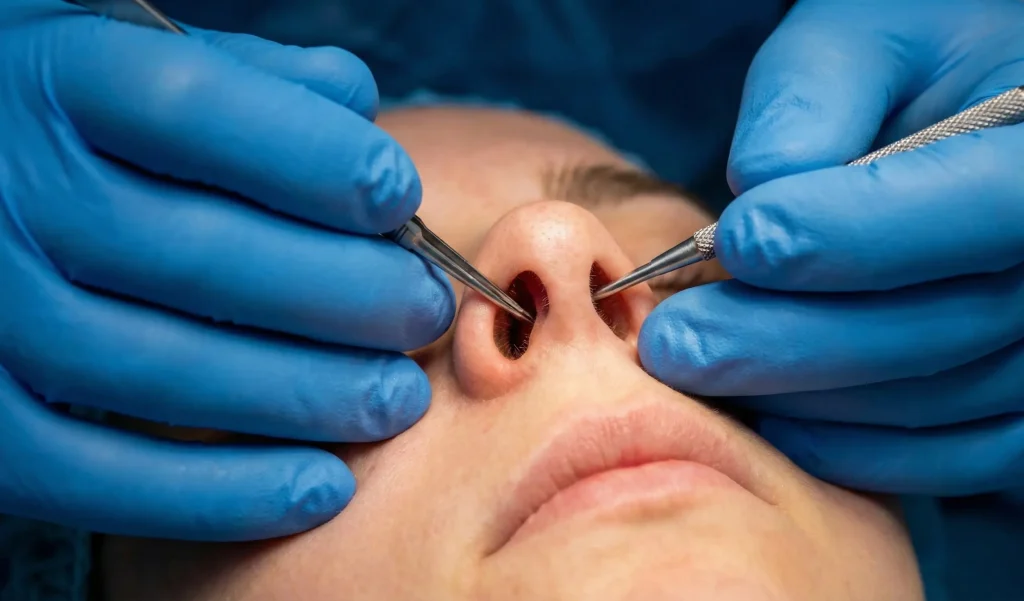
Their main difference is the surgical access. Open rhinoplasty includes a trans-columellar incision that enables the surgeon to separate the skin from the nasal framework, thus, having a direct, binocular view of the cartilages. Closed rhinoplasty, in contrast, is performed only via incisions inside the nostrils (marginal and intercartilaginous), thereby, not touching the skin bridge of the columella. Choosing between a better view and more preserved tissues is a very crucial part of the decision-making process for patients who are planning a trip to Turkey for their nose job.
Open Rhinoplasty: Visualization and Complex Reconstruction
Open rhinoplasty is characterized by the trans-columellar incision—a tiny, upside-down V or stair-step incision on the columella (the tissue separating the nostrils). If this is then extended with the marginal incisions inside the nostrils, the nasal skin can be degloved, exposing the lower lateral cartilages and the osseocartilaginous vault in their normal anatomical orientation. This degree of exposure is necessary when the surgeon needs to fix very unevenly formed noses, overly fleshy tips, or noses that have been injured and the cartilage is broken and scarred.
On a functional level, the open technique gives the surgeon the ability to perform delicate suture techniques that could hardly be done blindly. With the help of the microscope, surgeons can completely localize and hence precisely place interdomal sutures to bring the tip closer, or septal extension grafts to control rotation and projection. For this reason, open rhinoplasty is widely accepted as the best method of revision rhinoplasty and major structural repairs where the surgeon’s need to see is of the highest priority. The visibility allows the surgeon to diagnose the exact cause of airway obstruction or cosmetic irregularity and address it directly, ensuring that the structural integrity of the nose is reinforced against the forces of scar contracture.
Closed Rhinoplasty: Preservation and Ligament Integrity
Closed rhinoplasty, or the endonasal approach, is characterized by the absence of an external incision. It is therefore very challenging for an experienced surgeon who has a very good knowledge of the nasal anatomy and a sharp sense of touch to perform all the steps properly through the nostrils only. The major benefit of this surgical method is that it helps to retain the Pitanguy ligament as well as the nerves and lymphatic vessels running throughout the nasal tip. By keeping the denser connective tissue attachment, the post-operative nose quickly regains its blood supply and feeling.
With regards to the healing process, closed rhinoplasty has a significant advantage in terms of the dissipation of edema (swelling). The tip swelling caused by the operation is less than half as big as that experienced in an open rhinoplasty since lymphatic drainage of the columella is preserved. This method is particularly suitable for primary rhinoplasty patients who want a less prominent hump on the nasal bridge (dorsal preservation) or a slightly more refined tip but no extensive structural grafting. For those patients, the psychological benefit of no columellar scar, however small, is very significant in addition to the fact that it is less visible.
Structural Grafting and Tip Support Mechanisms
The decision to go for open rhinoplasty or closed techniques directly affects the variety of grafts that the surgeon will be able to use. Present-day rhinoplasty is all about maintaining the tip support which is one of the main strategies designed to prevent the nose from sagging (ptosis) over time. Open rhinoplasty makes it easier to put in a sturdy columellar strut graft—a piece of cartilage that is placed between the medial crura of the lower lateral cartilages. This graft functions like a tent pole, giving the tip projection a firm, fixed support that will last.
It is true that closed rhinoplasty makes it possible for surgeons to place struts, but without the direct vision, it becomes very hard for them to lock these grafts tightly into a stable pocket. Therefore, closed surgical approaches often tend to depend more on the strength of the cartilages already in place or on “floating” grafts. In the case of patients with weak cartilages or thick skin in whom significant projection is necessary to define the tip, the open approach gives a mechanical advantage by allowing the surgeon to build a tripod structure that can support the skin’s weight, thus, making the result seen on the operating table last for years to come.
Edema Resolution and Scar Maturation
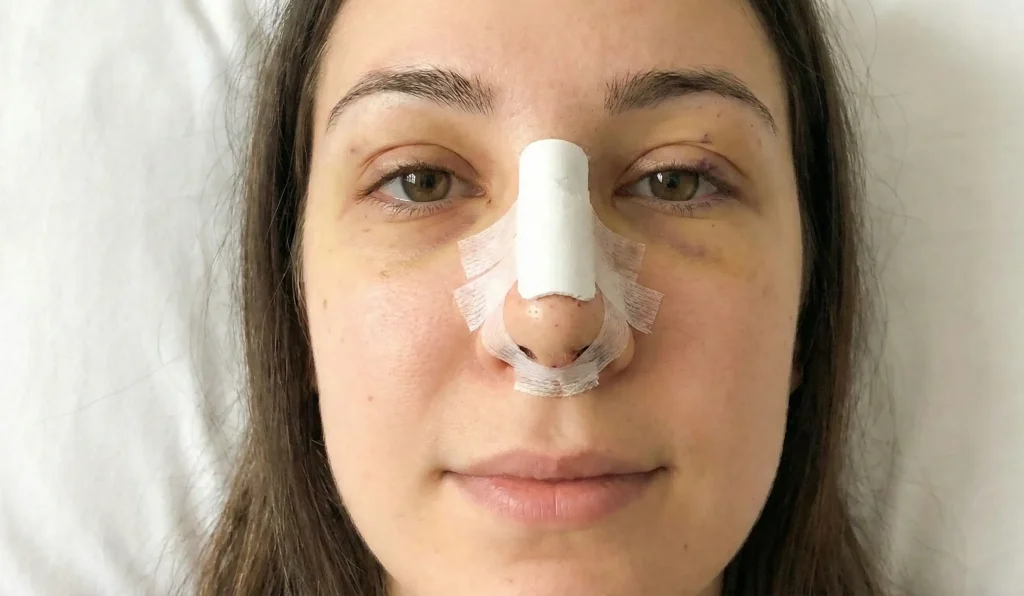
There is a drastic difference in the way patients heal from these two surgical techniques. Open rhinoplasty takes the trans-columellar incision through the nose’s superficial musculoaponeurotic system (SMAS) and venous drainage, so the patient usually gets supratip edema—swelling just above the tip—which can stay for 6 to 12 months and hide the newly reshaped nose. Over time, the red external scar will become barely noticeable, provided that it is closed well.
Conversely, patients who had a closed rhinoplasty recover more quickly and see the final outcome of the operation sooner with some even noticing it as soon as 3 to 6 months after the operation due to the preservation of the lymphatic channels. The endonasal incisions close by themselves or with absorbable sutures, so there is no need for removal of the one on the columella. However, as less area is visualized, small post-surgical asymmetries, if overlooked during surgery due to the lack of direct vision, may become evident when the edema subsides. Therefore, the “faster” recovery of the closed approach must be weighed against the “higher control” of the open approach.
Lin Health Europe Clinic Surgical Standards
At Lin Health Europe Clinic, we will never impose a “standard” method to everyone. Our medical team in Turkey is not only well-versed in the art and science of both open rhinoplasty and closed rhinoplasty but are also able to create a surgical plan that fits the patient’s individual anatomy. If, for example, a patient came to us with a very prominent dorsal hump but an essentially perfect tip, we would probably choose the less invasive closed, preservation approach to help the patient recover more quickly and suffer less trauma. On the other hand, if the patient needed complicated tip remodeling or was a case of revision, we would definitely go for the open approach to ensure that the structures would stay intact for the longest time possible.
Our clinic is equipped with Piezo (ultrasonic) technology which we can employ with either approach and that is capable of reshaping the nasal bones painlessly, without breaking them hence less trauma and bruising. We educate our patients in detail and make them understand that if it is a complex case, the precision that an open procedure gives is worth the tiny external scar that one hardly notices anyway. Regardless of it being an external or an endonasal method, Lin Health Europe Clinic is committed to delivering you not only a natural-looking face with which you can live harmoniously but also a properly functioning nose with a patent airway.
Frequently Asked Questions About Open vs Closed Rhinoplasty
The trans-columellar incision heals extraordinarily well and typically becomes invisible to the naked eye after a few months. Surgical specialists make the incision on the narrowest part of the columella to conceal it efficiently.
Indeed, the tip swelling goes down considerably faster since the lymphatic drainage vessels are not cut. Most patients get the recognition of their new nose several months earlier than with the open technique.
Definitely, septoplasty and turbinate reduction can be carried out very well through a closed approach. Structural grafting to open the internal nasal valve is also feasible from the closed side but it may be easier with the open approach.
One of the reasons why many surgeons go for an open approach is that it gives an unbeatable view of the nasal anatomy. Therefore, they can do complex structural grafting and precise symmetrical work that is almost blind-folded with the closed method.
No, it is generally the same for both techniques in terms of the level of postoperative pain. The main difference is the length of time for which the swelling lasts, rather than the degree of physical pain.
Gunter, J. P., & Rohrich, R. J. (1987). External approach for secondary rhinoplasty. Plastic and Reconstructive Surgery.
Tebbetts, J. B. (1994). Open rhinoplasty: to incise or not to incise? Clinics in Plastic Surgery.
Rohrich, R. J., et al. (2011). The lateral crural turnover graft: correction of the concave lateral crus. Plastic and Reconstructive Surgery.
Daniel, R. K. (1993). Rhinoplasty: An Atlas of Surgical Techniques. Springer-Verlag.