
It offers mild fat reduction, not dramatic results.
The idea of “melting fat away” without the need for any surgery is nowadays incredibly appealing, especially in the aesthetic world. Ads for machines that claim to freeze, heat, or zap fat cells into oblivion during your lunchtime with no downtime continue to flood patients’ minds. And the variants that are promoted, such as “Laser Lipo”, “Cryolipolysis”, and “Ultrasound Cavitation”, are generally considered as Non-Invasive Liposuction. The reality is that this categorization is false because, by definition, these procedures are not liposuction.
At Lin Health Europe Clinic, our priority is outright honest communication rather than clever marketing. Furthermore, of course, non-surgical technologies do have their role, yet in terms of results and thus the degree to which they can be predicted, they are completely different from surgical solutions. It is meaningless to ask only “does it work” since the other part of the question is “does it work enough?” When patients want a drastic change instead of merely a slight one, knowing the natural limits of the impact of non-surgical fat reduction will help them to prevent the situation of being disappointed and throwing their money down the drain.
The Biology of Reduction vs. Removal
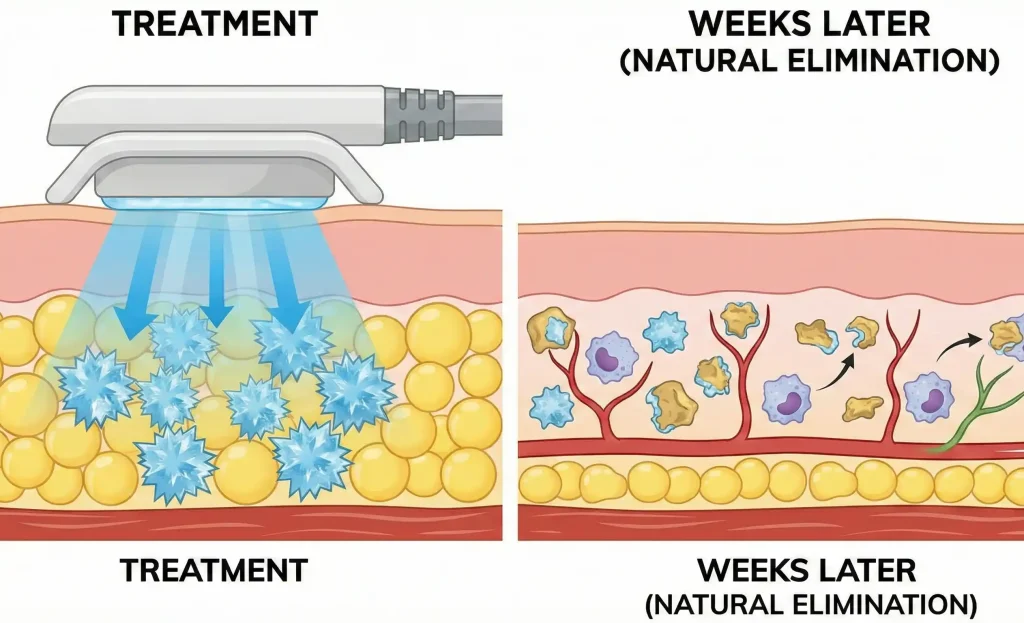
The cornerstone difference between surgical liposuction (for example VASER) and non-invasive treatments (like CoolSculpting or SculpSure) is the fate of the fat cell. Surgical liposuction removes adipose tissue physically from the body. The fat is suctioned into a bottle, and it is no more at that moment and for good. The patient experiences immediate structural changes upon waking up, even if swelling temporarily disguises them.
Non-invasive methods, however, depend on inflicting such a small extent of damage to fat cells that it would be enough to initiate cell death (apoptosis) or cause the cells to expel their content. In the case of the body’s immune system is the identification of these damaged cells involves breaking them down and eliminating them through the lymphatic system. This is a biological process that will consume months. As a consequence, the results are not going to be instant. You may have to wait for 12 to 16 weeks to see a 20% reduction in the treated area, whereas with surgery, you can get a 70% to 90% reduction in a single session. For those people who have considerable volume to lose, non-invasive methods are often biologically inefficient.
The Hidden Cost of “Cheaper” Treatments
One of the main reasons for patients’ attraction to non-invasive procedures might be that the initial cost of the single session is substantially lower than that of surgery. Yet, at the same time, this usually turns out to be a wrong business decision. Most non-surgical machines require 4 to 6 sessions of treatment to make a visible change, which even in most cases is still not as good as a single surgical procedure. When you multiply the total cost of all the sessions by the number of visits that have taken the time of work, the resulting figure is often equal to or exceeds the price of a surgical liposuction.
Moreover, one should not forget the factor of unpredictability. Whereas with surgery, the surgeon is in control of the outcome; he can see the result shaping on the table and keep controlling it until he gets the perfect result. In the case of non-invasive machines, the practitioner just places the paddle or laser and hopes that the patient’s body is going to react well. There are some patients, so-called “non-responders,” who do not experience any changes after getting several expensive treatments. Surgery eliminates this variable and guarantees changes in contour that consequently justify the financial and recovery investments.
The Skin Elasticity Factor
Among the various disadvantages of non-invasive fat reduction, it is the lack of the ability to effectively deal with skin laxity is probably the largest one. When you freeze or heat fat from the outside, you are largely ignoring the skin envelope. In the event that the patient has a certain degree of skin looseness and undergoes volume reduction, the lack of skin retraction may result in a deflated, crepey appearance that looks more aged than before.
The surgical liposuction, especially if done at the same time with the energy-assisted devices VASER or J-Plasma, treats the skin from the inside.
The heat that is generated during the internal ultrasound process stimulates the collagen fibers in the deep dermis, resulting in strong tightening. This is an effect that external devices just cannot replicate because they do not penetrate deep enough. Anyone over 35 or who has been through a major weight fluctuation knows that leaving the skin out of the equation is a surefire recipe for a disappointing aesthetic result.
Candidate Selection: Who Is It Actually For?
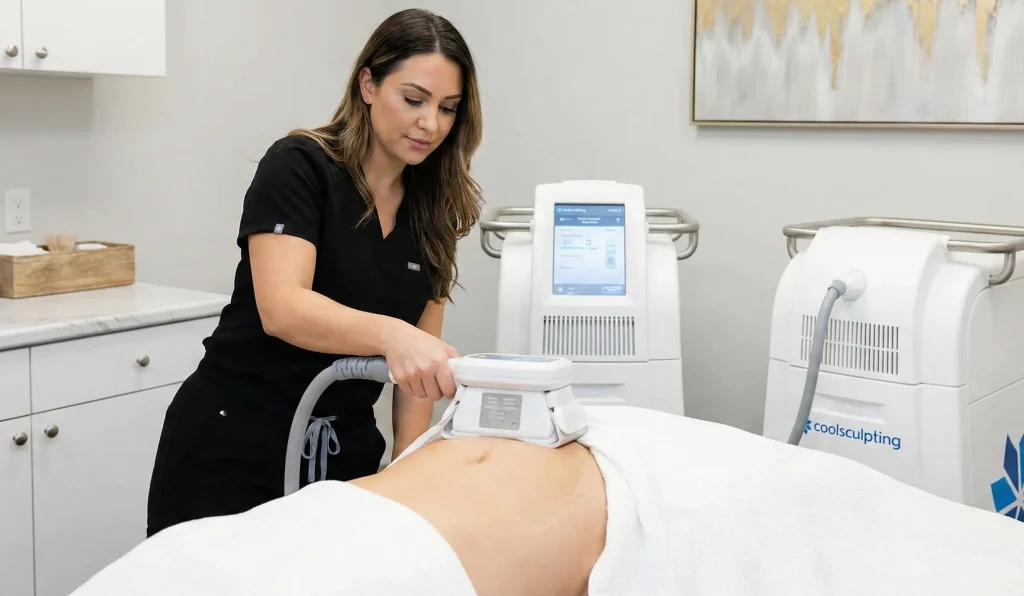
It does not imply that non-invasive treatments are totally ineffective. They are simply tailored to the respective very specific, narrow candidate profile. The perfect patient for non-surgical fat reduction is a person who has already reached his ideal body weight (BMI below 25) and has a tiny, stubborn pinch of fat—say a little bulge on the lower belly or chin—that is never going to yield. They are in fact searching for “refinement,” not “reshaping”.
Considering that an average patient is one who wants to change his silhouette, create curves, or simply shed the thighs or back significantly, non-invasive methods might be compared with a spoon trying to empty a swimming pool. If you can just spot the area where there is some fat, then you are a clear surgical candidate. In the case of large areas, the attempt to treat them non-surgically may result in changes being subtle, uneven, or even imperceptible, and therefore, that would not be in line with your transformation goals.
Why Lin Health Prefers Surgical Solutions
We at Lin Health Europe Clinic are focused on international medical tourists who come to Turkey mainly for the final, definitive results. For a patient who is flying in from the UK or Europe, a “maybe” result is out of the question. We cannot keep a patient coming back to have a laser session quite a few times. We must provide him with a “one-and-done” solution that will satisfy him in a single trip with no necessity of further reversion.
Hence, our choice is limited to advanced surgical methods only, like High-Definition Vaser Liposuction. We can assure our clients through a single intervention of the maximum combined safe fat removal, muscle sculpting, and skin tightening. The hospital setting and the use of anesthesia allow the procedure to be painlessly done and the recovery is efficiently managed by a professional.
Although the recovery period for the surgical procedure is longer than that of a non-invasive lunch break treatment, the result is a permanent, life-changing alteration of human anatomy which non-surgical machines may never be able to come close to achieve.
Frequently Asked Questions About Non-Invasive Liposuction
Not really. Fat freezing can only reduce the fat in one area by about 20 to 25 percent after a few months while surgical liposuction can remove 70 to 90 percent of the fat in the area instantly.
Yes. Once the fat cells are destroyed by freezing or heat, the body permanently removes them. Yet, the remaining fat cells can still get bigger if you gain weight.
Generally, no. The majority of non-invasive fat reduction devices don’t result in significant skin tightening. If you have loose skin, surgical methods with J-Plasma or Vaser are far more effective.
For most patients, a series of 4 to 6 treatments is necessary, and the treatments are usually weeks apart to see a significant difference. This is unlike surgical liposuction which is only one single procedure.
No. These treatments are ideal for small and stubborn pockets of fat for people who are almost at their ideal weight. They are not the right choice for large volume fat reduction or body reshaping.
Ingargiola, M. J., et al. (2015). Cryolipolysis for fat reduction and body contouring: safety and efficacy of current treatment paradigms. Plastic and Reconstructive Surgery.
Mulholland, R. S., & Paul, M. D. (2011). Noninvasive body contouring with radiofrequency and laser energy. Clinics in Plastic Surgery.
Jewell, M. L., et al. (2002). Clinical application of VASER-assisted lipoplasty: A pilot study. Aesthetic Surgery Journal.