
Only if overfilled; proper technique keeps it natural.
The “snatched” jawline has been the most sought-after facial feature of the current generation. With the rollout of celebrities with ultra-chiseled faces, many patients seek jawline filler to create definition out of areas that nature has made soft. Nevertheless, with this demand emerges a very peculiar fear: “I want a sharp jawline, but I don’t want to resemble a Lego character.”
This fear of getting a “boxy,” masculine, or heavy face is quite reasonable. We have all witnessed a situation when a patient comes out with a lower face that is even wider than their cheekbones, thus totally spoiling the feminine heart shape. Jawline filler by itself cannot make you look boxy; only a badly planned filler can. At Lin Health Europe Clinic, we treat the jawline as a mathematical problem. It’s about the angles, not just the volume. Discerning between “widening” the face and “defining” the mandible will allow you to obtain a result that is not only sculpted but also not square.
The Geometry of Gender: 120 vs. 90 Degrees
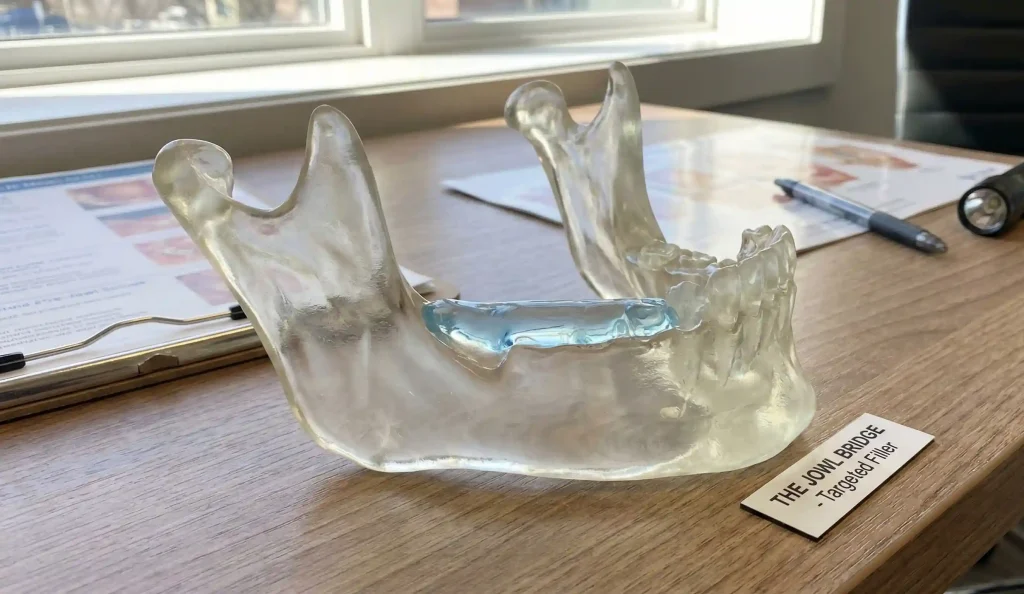
To ensure a non-boxy outcome, the doctor who performs the procedure has to honor the naturally existing differences in the skeletal structure. The male jaw is usually more square-shaped than a female’s and is defined by a sharp, almost 90-degree Gonial angle (jaw corner under the ear) and a broad, flat chin. This forms a traditional “blocky” shape that is the hallmark of masculinity.
A female’s jawline is different. Ideally, it should have a softer and more obtuse gonial angle of 120-130 degrees, slanting down gently to a chin that is narrower and tapered. The “boxy” effect results from an injector attempting to impose a 90-degree angle on a woman’s face. In order to make the “jaw sharp,” they put an excessive amount of dense filler at the jaw corner and thus inadvertently widened the lower face. If the width of the jaw becomes equal to that of the cheekbones, the face will lose its V shape and will turn into a square. We steer clear of this by limiting the amount of the product that is put laterally (at the ear) and concentrating on the slope.
The Chin Connection: The Anchor of the V
You cannot treat the jawline as a separate entity. The jawline is actually a line that connects two points: the angle (ear) and the chin (mentum). If you extend the angle of the jaw without bringing out the chin, the face will resemble a rectangle.
In order to avoid boxiness, we use jawline filler along with chin filler almost every time. This is the trick behind the “V-shape.” When the chin is projected slightly downward and forward, we lengthen the face. Hence, a triangular focal point is formed. It does not matter if we give the jawline more definition; if the chin is the narrowest point of the face, the end result will be feminine and slim. A square face is a jawline that is not complemented by a prominent chin.
The “Jowl” Trap: Camouflage vs. Bulk
Often, patients who want jawline filler are actually aiming to conceal the early signs of aging: Jowls. A jowl is a small accumulation of fat hanging below the jawline, thus disrupting the clean straight line.
The standard procedure to correct this is “pre-jowl sulcus filling”; filler is inserted into the depression right in front of the jowl, thereby camouflaging the dip. Although this method is effective, it may be risky. If an injector makes the hollow so full with filler to hide a heavy jowl, he/she will cause the entire lower face to be thick to match the width of the sagging fat. This technique results in the straightening of the jawline, but also in the thickening and rounding of the lower face. For heavy jowls, the remedy is not filler; it is liposuction or a thread lift for the removal of the excess before defining the edge.
Product Choice: Bone, Not Fat

The result is the major factor in deciding the product type; more specifically, whether it will be a crisp or puffy result. The jawline is the part of our body that needs to be structurally supported. What we actually require is a product that will behave like bone.
In the event of the use of a soft and hydrophilic (water-attracting) filler on the jawline, it would soak up water and be distributed into the surrounding tissues. This would lead to the blurring of the line you were aiming to make and thus to a “doughy” and swollen look that adds to a boxy face. At Lin Health Europe Clinic, we only use High G-Prime (high elasticity) types of fillers such as Juvederm Volux or Restylane Lyft. These gels are hard and cohesive, which means they do not move from the spots where they are injected, but push the skin in the direction of the projection, thus creating a sharp shadow without spreading into the cheek or neck.
Lin Health Europe Clinic: The “Posterior Lift”
In the quest to achieve a defined jawline without bringing about the widening of the face, there is a special method called the posterior jawline lift which we employ here at the clinic. Instead of the product being put on the side of the face (which is adding width), the filler is injected in the space between the masseter muscle and the posterior edge of the bone at Lin Health Europe Clinic.
This is the way in which a vertical lift is created. The skin on the neck and chin is pulled backward, and at the same time, the neck skin is tightened just like when making a ponytail. By using this “back of the head” way to attach skin, the natural bone definition that is hidden will become visible with no addition of mass to the external part of the jaw. Hence, this technique gives the angle from the profile view (allowing you to look sharp in photos) whilst also keeping the front view slim and tapered so that the risk of looking “bottom heavy” is eliminated.
Frequently Asked Questions About Jawline Filler
No, definitely not if the treatment is done properly. On the other hand, if filler is administered at a shallow depth or misplaced (for example, in the cheek area), this can cause unwanted volume. Bone structure placement is used to highlight, not to bulk up the face.
The jawline covers a significant surface area. To get a visibly well-defined contour, it generally takes about 2 to 4 ml (syringes) of filler to be used in the areas of the angle, the body of the mandible, and the chin.
It’s only if the doctor changes the gonial angle to 90 degrees. An experienced injector will keep the angle soft and obtuse (120 degrees) and concentrate on chin projection to achieve a feminine V-shape.
Since the filler is placed next to the masseter muscle, you might experience a little soreness or a “tight” feeling when chewing for 2 to 3 days. This will get better very fast and naturally.
It is generally the case that jawline filler lasts longer – up to 12 to 18 months and more before needing a touch-up than lip filler because the fillers that we use here are of a high-density, and structural type, and in addition, the jawline is an area of less movement than the lips.
Swift, A., & Remington, K. (2011). Beautiphication: a mathematical approach to facial analysis. Clinics in Plastic Surgery.
Braz, A., & Humphrey, S. (2018). Update on Aesthetic Treatment of the Jawline. Dermatologic Surgery.
Raspaldo, H. (2010). Volumizing effect of a new hyaluronic acid sub-dermal facial filler: a retrospective analysis based on 102 cases. Journal of Cosmetic Laser Therapy.