A nose surgery using a small external incision.
As soon as patients start to investigate nose surgery, they come across two main methods: Closed Rhinoplasty and Open Rhinoplasty. The closed method is usually advertised as the “scarless” option; however, the Open Rhinoplasty remains the preferred method among most of the world’s leading surgeons, especially for complicated cases. Nevertheless, the word “open” can sound quite scary and might even make people think of big surgery and a visible scar.
Open Rhinoplasty technique, in fact, is not any more invasive than the closed. The main difference is that it provides the surgeon a better view and control over the work. The procedure includes a small incision, which enables the surgeon to lift the nasal skin to see the cartilage tissue fully.
One could compare it to the difference between being in a dark room and trying to find things in a drawer by feeling and in a lit room where you can see perfectly what you have done. At Lin Europe Clinic, our philosophy is that for those who want to remold the shape of a nose tip or correct the asymmetry and projection, Open Rhinoplasty is the way to go as it offers the surgeon a level of control and predictability that is simply unmatched.
The Anatomy of the Approach: The Columellar Incision

The main thing that sets the Open Rhinoplasty apart is a very small cut extended over the columella—a narrow strip of flesh that separates the nostrils. Such a cut completes the ones supposed to be inside the nose (which happen in both open and closed methods).
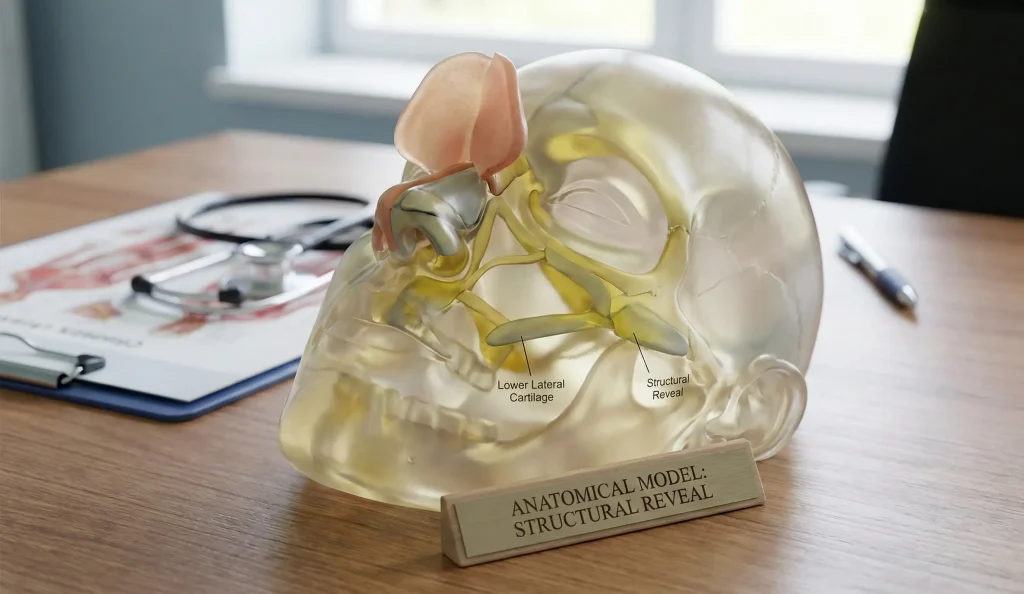
As soon as such a tiny break is made, the specialist can gently take off the nose skin a little bit as when one lifts the car hood to check the engine. What is found beneath is the nasal skeleton—the bones and the cartilage—which is here shown in the natural state and undisturbed. While in a closed rhinoplasty the surgeon has to operate through the freedom tunnel, relying a lot on the sense of touch, the open method, on the other hand, yields the direct, wide, line-of-sight view of the anatomy. In this way, the doctor can find even the smallest asymmetries of just a millimeter which otherwise he might have missed.
Unmatched Visibility: The “Hood Up” Advantage
Given there is an extra step in this technique, why is it the preferred method? It boils down to structural reconstruction. Different aesthetic concerns, such as a tip that looks a bit round, a nose that has a crooked shape, or a tip that points down, generally need a surgical reconstructing. The doctor is going to take some pieces of the cartilage and sew them to make a new, strong frame.
Thanks to the Open Rhinoplasty technique, the surgeon will be able to work on the sutures with flawless accuracy. The operation is carried out with the full consideration of the face in the mirror. The grafts are fixed (by spreader grafts or columellar struts) in such a way that they are very unlikely to get moved with time. This method is basically recommended, in case of Revision Rhinoplastys, when the scar tissues of the previous surgeries have changed the shape of the nose. The “open” view gives the surgeon the method to do the safe dissection of the scar tissue that can be restored to the structural integrity of the airway
The Truth About the Scar: The “Inverted V” Technique
What patients are most scared of when it comes to the Open Rhinoplasty is the scar. Will everyone notice it? Most likely the answer is no. In order not to see the scar, we don’t perform a straight cut. We resort to the specialized technique called the “Inverted V” or “Stairstep” incision.
When one cuts in a zig-zag pattern, one breaks the visual line, making it way more difficult for the human eye if not impossible to notice. Besides, such a form enables the skin edges to get together like puzzle pieces, thus, during the healing without tension. Once the stitches are taken off, the scar is red; however, after a few months, it gradually turns into a tiny (microscopic) white line that gets hidden in the natural shadow underneath the nose base. Only if someone were to look right up to your nostrils from a few inches away will they see the scar; otherwise, they are practically invisible.
The Swelling Trade-Off: Patience for the Tip
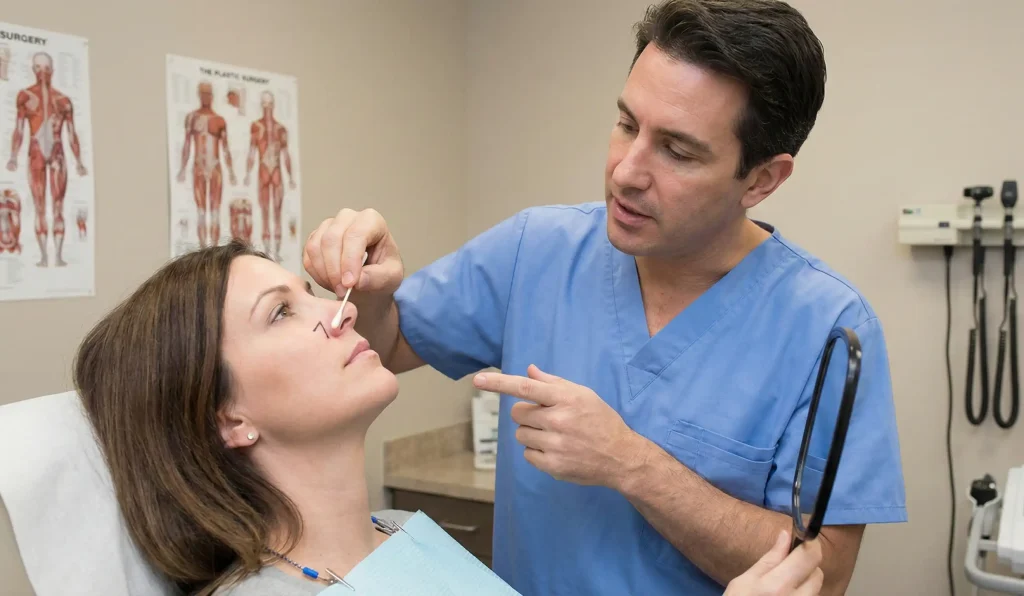
Besides superior results, the Open Rhinoplasty technique also has a specific drawback: Tip Swelling (Edema). After separation of the skin from the cartilage, the superficial lymphatic drainage vessels are temporarily severed.
It follows that the fluid trapped longer in the nasal tip as compared to a closed operation. Patients need to be ready for the “not very clear” time. A nice-looking bridge comes pretty soon, but the tip may appear round or swollen for months. As the lymphatics get reconnected and the skin shrinks, it can take from 12 to 18 months for the tip to show the final, crisp definition. This is, without doubt, a matter of patience, whereas the benefit here is a nose with a structural integrity that just won’t flaw or collapse even as you get older.
Lin Europe Clinic: Structural Integrity
At Lin Europe Clinic, we put the long-lasting aspect of the final result at the forefront, and not how fast the patient’s recovery is. Most of the time, we advise our patients to undergo Open Rhinoplasty since it significantly helps to make a nose that will last for the whole life. We use Piezo (Ultrasonic) Technology while we have the open view on the nose to gently shape the bones and keep the trauma caused to the surrounding soft tissues at minimum.
We also see the closure of the columellar incision as a microsurgical procedure and use a suture thinner than a hair to make the scar heal perfectly. We also give you the precise instructions on post-operative taping to help you manage the tip swelling which is a challenge of the open technique. Getting a sufficiently accurate and harmonious aesthetic result, with better breathing and symmetry is what you are doing if you choose the open path.
Frequently Asked Questions About Open Rhinoplasty
No. A columellar scar resulting from an Open Rhinoplasty generally fades into a barely seen, thin white line within a year, naturally concealed under the nose base.
Yes. An Open Rhinoplasty cuts through lymphatic drainage more than closed techniques, causing swelling in the nasal tip that extends into 6 to 12 months of tip swelling.
Open Rhinoplasty gives the surgeon an opportunity to work on the tip cartilages directly and suture them with a high degree of accuracy, therefore it is a better technique for reshaping and narrowing a wide, bulbous tip.
Columellar external stitches are usually taken out 6 to 7 days after the Open Rhinoplasty operation.
Yes. With the Open Rhinoplasty method (septorhinoplasty), the surgeon has a clear line of sight for trimming and straightening the breathing-limiting part of the septum (deviation).
Gunter, J. P. (1990). The merits of the open approach in rhinoplasty. Plastic and Reconstructive Surgery.
Toriumi, D. M. (2006). Structure approach in rhinoplasty. Facial Plastic Surgery Clinics.
Foda, H. M. (2003). External rhinoplasty: a critical analysis of 500 cases. The Journal of Laryngology & Otology.