They age naturally with your body.
In general, if you check the before and after images of the breast augmentation, you will find out that the after photo is usually taken 3-6 months after the operation. By this time, the inflammation has gone away, the implants have adjusted to a very good visually pleasing position and the skin is firm and even. This is the “honeymoon phase” of plastic surgery. However, patients are seldom shown pictures of those same breasts 10, 15, or 20 years later. Since there is no long-term monitoring, people wrongly assume that implants are a permanent “pause button” on aging, which is why the breasts remain high and firm forever.
The answer to the question, “How do they look over time?” is partly biology and partly physics. Even though the implant itself (especially silicone) hardly changes, your body keeps aging around it. The combined effects of gravity, changes in body weight, menopause, and skin elasticity explain why the implant and your chest wall won’t be in the same relationship as today. At Lin Europe Clinic, we do not only prepare you for the short run but the marathon as well. Being aware of the natural course of a breast augmentation helps you to go for the size and location that will age well with you in the future.
The “Golden Era”: Years 1 to 7

Most women consider the first 7 to 10 years as the “Golden Era” of their results. The initial tightness of the pectoralis muscle (if the implant is placed dual-plane) during this period will relax and the implant will settle into a shape that looks completely natural like a teardrop. As the body accepts the implants, they feel softer and the scars are almost invisible.
Still, subtle changes take place even during this “prime” time. The upper pole fullness (the “cleavage” slope) will naturally decrease, although only slightly, as the force of gravity slowly pulls the tissue down. Actually, this is what most patients want because the breasts don’t look so “fake” anymore and instead resemble naturally endowed breasts. Your breasts during this time will probably be even more attractive than immediately post-op ones because they behave more like natural tissue unless you have a complication such as a capsular contracture.
The Thinning Effect: Rippling and Visibility
As we hit the second decade (10+ years), the major change will be Tissue Atrophy. With aging and hormonal changes (particularly when getting closer to menopause), the breast glandular tissue and fat layer under the skin will most likely decrease. Let me illustrate this by saying that your breast is like a pillow with a pillowcase around it. The pillow (implant) remains the same size, but the pillowcase (your skin and meat) becomes thinner and more fragile.
However, this thinning happens to reveal your implants’ edges. You may notice rippling—these are crests or valleys in the breast on its sides or in between the breasts. It is not an implant defect; it is just that you do not have enough natural padding with which to hide the device. In fact, those who opt for very large implants tend to expose themselves to this risk, as the heavy weight leads to the faster thinning of the tissue cover over the years.
The Gravity Battle: “Bottoming Out” and Ptosis
Gravity is an invincible enemy for all breast surgeries. Your body parts do have weight so the addition of implants on your chest can increase the front of your chest’s weight by almost a kilogram if the implants are of 400cc each. Over a period of 10 or 15 years, this additional weight keeps pulling on the skin and ligaments inside the breast. At last, the skin will stretch.
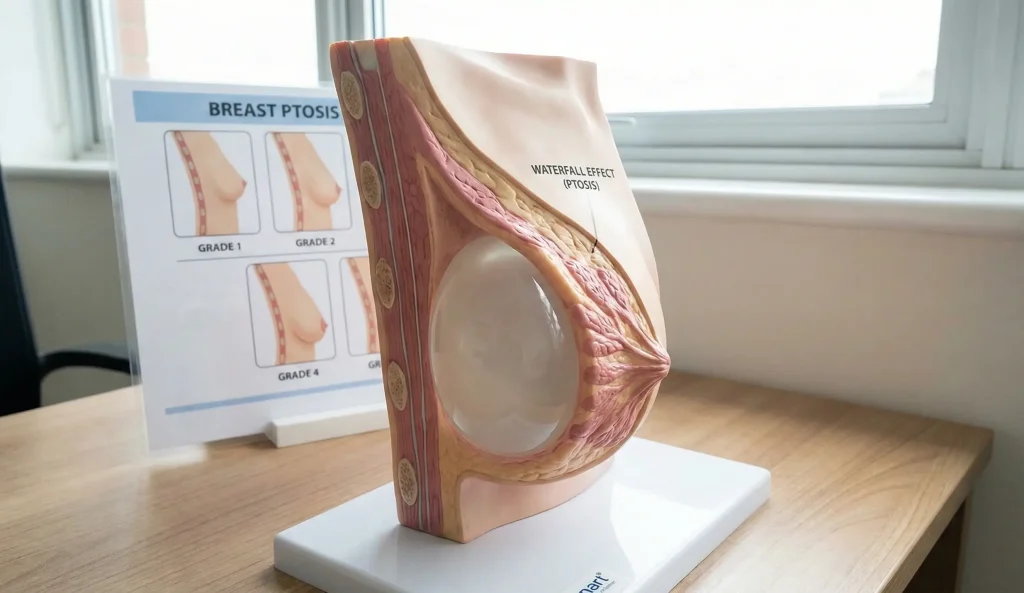
This phenomenon can be seen in two different forms. The first one being “Bottoming Out”, which is the state of the uterine prolapse when the implant slides down below the natural breast crease, making the nipple look too high on the mound. Secondly, there is Recurrent Ptosis (Sagging). Even though the implant is kept in a good position (the scar capsule is holding it), your natural breast tissue slides off the front of it, drooping downward. This causes the “Snoopy Nose” or “Waterfall” deformity, which is the nipple points down while the upper breast remains round. In their 40s or 50s, this is the main reason that women return to the doctor for a “lift and exchange” operation.
The “Waterfall Effect”: When the Breast Slides Off

The waterfall deformity is a very distinctive one among the implant aging group of patients. When implants are underneath the muscle, this happens mostly. The muscle will therefore keep the implant elevated and backstage the ribs but at the same time the natural breast tissue in front of the muscle will age and sag like any other tissue.
And so, the breast tissue goes off the implant, coming down the chest wall. Eventually, you are faced with the implant standing high (thus giving upper fullness) and the natural breast hanging low (thus nipple droop). Note that the breast profile will be double-mound. This can only be corrected by an operation that involves lifting the breast tissue and securing it over the implant, thereby tightening the skin envelope again.
Bone Loss and Chest Wall Changes
One of the aspects of aging that rarely comes up is lasting skeletal changes. It is common for there to be changes in bone density and posture in women after menopause. The ribs may subtly change their shape or the spine may develop a curvature (kyphosis).
These changes in body structure may affect how the implants are oriented. Breasts that were perfectly symmetrical at 25 may look slightly asymmetric at 55 due to the shifts in the skeletal frame. Moreover, a reduced pectoral muscle mass implies the area on top of the implant will have less padding, thus the transition from the collarbone to the breast will be more sudden and less smooth as it was at a younger age.
Preventive Planning in Turkey
At Lin Europe Clinic in Turkey, we adopt a surgical philosophy that puts longevity over everything. Because we can see all the problems that come afterwards, we do not allow mega-implants for young patients. Implanting a 20-year-old with a huge implant will surely cause serious sagging and thinning by the time they are 35.
We promote “Goldilocks Sizing,” that is, the size of the implants that would be in harmony with your chest width and tissue strength, rather than the use of massive implants. The majority of the time, we incorporate internal support mechanisms (such as an Internal Bra (Mesh)) or very careful management of the pocket to resist the force of gravity from the very first day. To further support their decision, we also portray breast augmentation as a relationship rather than a transaction; hence, we are always there for you with revision, lifting, or fat grafting maintenance as your body goes through changes over the years.
Frequently Asked Questions About Long-Term Results
Breast implants, like natural breasts, are targets of gravity. The weight that the implant adds to the breast can even speed up the process of skin-stretching and eventually, the breasts will sag (ptosis) in about 10-15 years.
No, there is no such medical regulation that is tied to implant replacement every 10 years if you are not having any problems. However, most women opt for a revision surgery after 10-15 years to fix sagging or changes in the size of their breasts.
In this situation, the implant remains up high on the chest (normally the muscle is holding it in place) while the natural breast tissue droops and slides off it, thus a “double bubble” look is formed.
No, implants only add volume and do not serve as a lift; in fact, the use of large implants alone may worsen sagging by putting more weight on the skin.
Absolutely, an implant’s age has nothing to do with the ability to breastfeed, but pregnancy will stretch the skin of the breast, which can change the cosmetic appearance of your results after a long period.
Maxwell, G. P., & Gabriel, A. (2014). Biofilms and breast implant contracture: Was the era of texture a mistake? Aesthetic Surgery Journal.
Handel, N., et al. (2006). Long-term safety and efficacy of polyurethane foam-covered breast implants. Aesthetic Surgery Journal.
Spear, S. L., et al. (2003). The “dynamic” breast: The role of the pectoralis major muscle in breast augmentation. Plastic and Reconstructive Surgery.