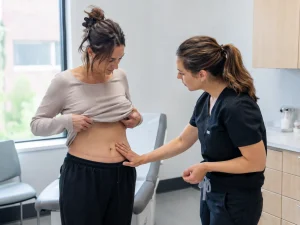
It reduces discomfort and speeds recovery.
For a long time, whenever we thought of plastic surgery recovery, it involved surgical drains. These are basically plastic tubes that come out of the body and collect blood and other fluids in small bulbs that you can clip to your clothes. Despite their effectiveness, drains are pretty much universally hated by patients. They are unpleasant, difficult to shower with, and lead to additional scarring. Not surprisingly, the advent of a “Drainless Breast Augmentation“ has caused a lot of enthusiasm. Patients often want to know, “Can I skip the tubes?”
Generally speaking, the answer to “Is it better?” is yes for most primary breast augmentation patients. A drainless procedure can provide a more comfortable recovery and less scarring and infection risk. Still, a drain-free outcome is something that requires a surgeon with impeccable techniques. At Lin Europe Clinic, we employ cutting-edge “No-Touch” and hemostatic” protocols which help us make sure that when coming off a drain, the patient won’t get a seroma (fluid buildup). We tell you how we accomplish this streamlined recovery.
Why Did They Use Drains Initially?
First of all, to get rid of them, you have to understand what they are for. Drains serve as a fall back plan. When undergoing surgery, cutting into tissues causes damage to small blood vessels and lymphatic channels. After the wound closure, these vessels may continue to ooze fluid. If such fluid (seroma or hematoma) accumulates in the breast pocket, it can result in pain, infection, or capsular contracture (scar tissue hardening). Drains were the conventional method of withdrawing this fluid until the body ceased fluid production.
The “Dry Pocket” Technique
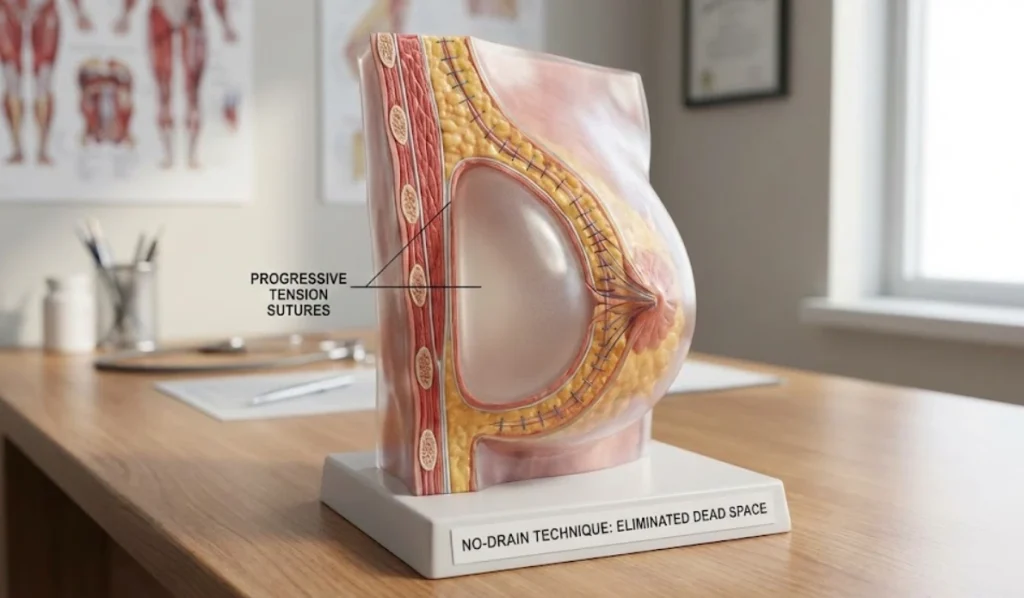
The trick to drainless surgery is not only “refusing to put them in“; it is a major change in surgical accuracy. We use a “Dry Pocket” technique. In the case of an operation, instead of cutting tissues harshly and then handling the bleeding as a secondary issue, we use high-tech cautery instruments (such as electrosurgery) to close off each tiny blood vessel as we cut.
By maintaining total hemostasis (no bleeding) during the operation, there is no blood left in the pocket to drain from. We basically eliminate the problem even before it arises. The carefulness of this method only takes a little more time in the operating room, but it spares the patient weeks of inconvenience during recovery.
Keller Funnel’s Role
One of the main elements that drainless surgery relies on is the Keller Funnel. It serves as a sterile cone-shaped sleeve, kind of like a pastry bag, through which the implant is delivered. Usually, the surgeon would insert the implant with his/her fingers, potentially causing friction and micro-trauma to the pocket tissues which in turn leads to the production of fluid.
We pass the implant into the breast through the Keller Funnel without it making contact with the skin or the edges of the incision at all. Thus, the “No-Touch” technique prevents trauma and contamination. Less trauma results in less inflammation and hence less fluid production making a drain unnecessary.
Advantages of Drainless Surgery
- Reduced Pain: Drains are frequently reported as the most painful part of the whole recovery. You get completely rid of the feeling of a tube being inside your body and the pain that comes with it when the tube is pulled out.
- Decreased Risk of Infection: A drain is a two-way street. It lets fluid out, but at the same time, the spot where the tube enters is a potential door for bacteria to get in. Eliminating the drain means taking away this infection source.
- Better Scarring: Placing drains means either making a separate stab incision (another scar) or running the tube from the main incision which may cause distortion of the healing line. Drainless surgery results in less visible and smaller scars.
- Better Hygiene: You can frequently shower 24 to 48 hours post-surgery since you don’t have to deal with drain sites or keeping bulbs dry.
Disadvantages of Drainless Surgery
The risk of seroma can hardly be eliminated completely even if you have a good surgeon and hemostasis is achieved. Seroma means that fluid caused by inflammation, blood plasma that leaks out of the damaged vessels, accumulates and forms a pocket. If it is not severe and painful, the fluid can be reabsorbed by the body eventually.
Besides, the surgeons from Lin Europe Clinic perform revision cases regularly and are capable of doing it drainless most of the time. However, it is always safer to leave drainage in such cases to avoid complications and so that the patient recovers quicker overall.
Are Drains Still Necessary Sometimes?

In 95% of breast augmentations, we aim for drainless surgery; however, there are specific cases where the continued use of drains is justified from the safety standpoint. For example, services such as Revision Surgery (replacing old implants) and Capsulectomy (removing scar tissue) usually require the help of drains. Here, the surgeon has to separate peeled tissue layers that tend to produce more fluid than normal “virgin” tissue.
Likewise, combining Breast Lift (Mastopexy) or Breast Reduction with implants results in extensive tissue reshaping that creates a larger internal surface area. This makes drains a sensible precaution for a few days to prevent seroma.
Breast Augmentation in Turkey
When it comes to a breast augmentation in Turkey, your choice of Lin Europe Clinic is a claim that patient comfort is as important as surgical excellence. Our doctors in Istanbul are well versed in the latest “Rapid Recovery” protocols. They cleverly combine drainless techniques with long-acting local anesthetics (intercostal blocks) to bring out the best result, i.e., quite a number of patients are able to leave the hospital on the same day in a state of fair comfort.
We are free of medical clutter during your stay in Istanbul. By not having to deal with drains, you can move, dress and sleep in your hotel like you did before surgery. We keep a close watch on your condition but we think your recovery should be all about resting and not emptying plastic bulbs. Here at Lin Europe Clinic, we make use of precision to make your trip to getting new breasts as simple as possible.
Frequently Asked Questions About Drainless Surgery
Certainly, multiple studies have verified that in a primary breast augmentation, performing the surgery drainless is equally safe as the use of drains if a meticulous hemostasis is done during the surgery.
When done perfectly by a skilled surgeon employing “dry pocket” methods, the seroma risk is very low. Nevertheless, a high level of activity too shortly after the operation can lead to fluid, so rest is still very important.
Absolutely. The majority of patients express that their discomfort is greatly diminished because there is no foreign body (tube) causing irritation to the internal tissues or the skin exit site.
Mostly, yes. Lacking drain sites to keep dry, most surgeons are on the same page that patients can take a shower within 24 to 48 hours provided that the major incisions are covered with waterproof glue or tape.
There are some surgeons who are of the opinion that drains are a safer measure, and, furthermore, they may use them in complicated cases (like revision or lift) where the formation of fluid is more expected. It is both a matter of preference and the specific surgical scenario.
Adams, W. P., Jr. (2012). The use of drains in breast augmentation. Plastic and Reconstructive Surgery.
Calobrace, M. B. (2018). The safety of the “No-Touch” technique in breast augmentation. Aesthetic Surgery Journal.
Wan, D., & Rohrich, R. J. (2016). Revisiting the management of the breast augmentation pocket. Plastic and Reconstructive Surgery.