
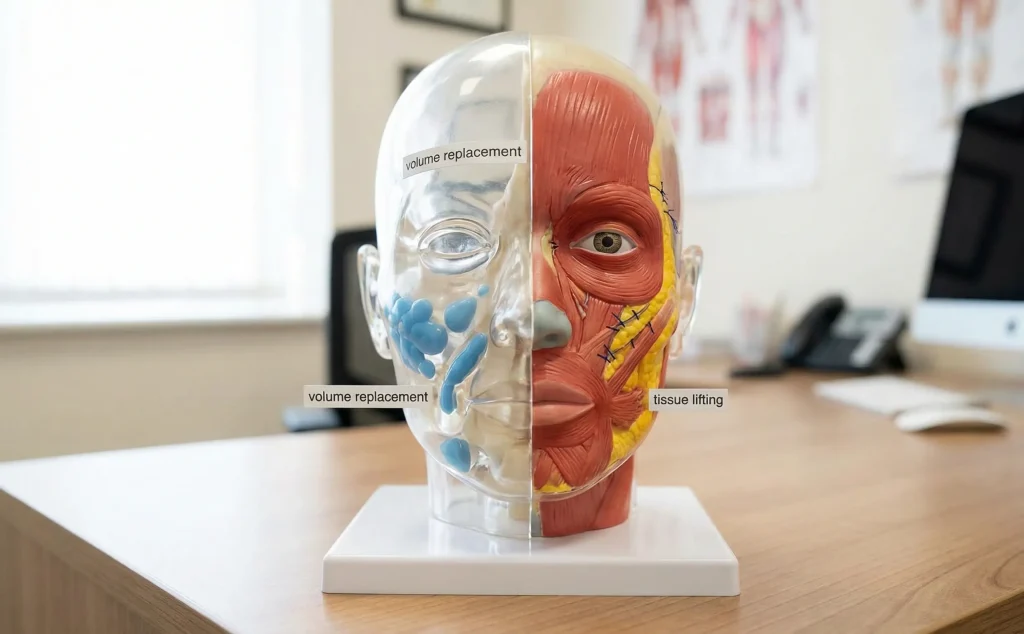
A facelift offers longer-lasting results than fillers.
Well, it typically begins quite innocently. In your early 30s, you spot some minor lines around your mouth and decide to have a bit of Botox. A few years later, you might dabble in your first syringe of filler to lift your cheeks or cover up your under-eye dark circles. The reaction is immediate, pleasing, and, to tell the truth, a tad bit addictive. You appear well-rested, your skin looks fresh as if you had just returned from a trip. However, nature is unforgiving. With time, weight of gravity wins over, the skin loses its elasticity, and the fat layers beneath the skin gradually slip down. You end up using more and more product just to “hold the line“. Eventually, you hit the limit. You look in the mirror and see that while your wrinkles have gone, your face appears heavy, puffed, or oddly distorted.
This is the critical moment. This is the instant when the question changes from “What filler do I need?” to “Is a facelift better than fillers?” At Lin Europe Clinic, we explain to our patients that this is not simply a decision between a surgical and a non-surgical treatment. It is a decision between two entirely different mechanisms: slipping the signs of aging or genuinely fixing them. Knowing the distinction between filling a void and lifting a weight is the only way to prevent the dreaded “overfilled” appearance and make the choice that you will be proud of.
The Liquid Trap: What Fillers Can (and Cannot) Do

Dermal fillers are looked at as little miracles in aesthetic medicine landscape, however, they possess a major shortcoming: they are helpless against gravity. Their function is to compensate for the lost volume. When it’s just a few hollows here and there and you are young, they can work wonders. They reinflate the deflated balloon.
On the other hand, if the problem is jowls, loose skin of the neck, deep folds on either side of the nose and mouth, volume is not the issue; it is skin that is not pulled tight enough. Trying to treat sagging skin with filler is both foolish and dangerous. To “lift” a heavy, sagging cheek with gels alone, you must inject huge amounts of the product to make a kind of “tent-pole.” The consequence is the famous
“Pillow Face” or “Alien Face” syndrome. The person’s whole characteristics get lost under a layer of hyaluronic acid. The face turns into a round, stiff, and waxy mask because the filler is a type of support that it was never supposed to be. To get an absolutely smooth-looking skin you end up sacrificing your normal natural contours from a craving for perfection.
On top of it, we are now certain that filler is not always resorbed when expected. MRI scans provide evidence that it can move and remain for years, thus creating a thick layer under the skin surface that, when combined with the weight of the face, actually drags it down.
The Surgical Reality: Restoring the Architecture
A facelift literally works on a different principle. It is a method of balancing and subtracting. Instead of pumping the face to conceal the looseness, the surgeon physically draws the underlying muscle (SMAS) level to what it was 10 years ago and removes the redundant skin.
Whether a facelift is better than fillers? The answer is an unqualified yes for anyone who has true sagging or loose skin. Surgery brings back the structure of the face. The jawline gets its definition again just because the skin is in close contact with the bone after the operation, not because the thick gel was used to camouflage it. A facelift changes your face from the aged square shape to the youthful heart shape—something no amount of injection can achieve unless the result looks freakish.
The Neck: The Great Divider

There is one thing that puts an end to the discussion immediately—the neck area. Fillers do not go beyond the jawline. If you have what people call turkey neck, platysma bands, or draping skin below your chin, then it is simply impossible to solve the problem with an injection. If you add filler to the jawline to conceal a sagging neck, it usually just makes the lower face appear broader and more masculine. Only a facelift (frequently done alongside a neck lift) can return that sharp line that forms a 90-degree angle under the chin—something that is regarded as a sign of youth. So, if the neck is what bothers you, then in terms of your surgery is not better but actually is the only option.
The Economics: Renting vs. Buying Youth
Well, money plays a big role, so let us discuss it. Fillers might seem cheaper only because of the initial cost which is lower. However, fillers are basically youth on lease. They do not last long. To keep your looks, you will be trapped into a procedure of coming back to the clinic every 6 to 9 months and paying per syringe. Over 10 years, it is quite easy for a patient to spend a fortune on fillers only to end up with a puffed and distorted appearance.
In a way, a facelift is like buying a house. You make a big one-off payment going in, but what you get is a permanent change in your physique. Aside from continuing to age, the extent of the lift will have the effect of turning back your biological clock by approximately 10 years. If you really do the math, surgery is probably more cost-effective over 10 years than the cumulative amount it costs to keep coming for injections.
The Hybrid Solution in Turkey
At Lin Europe Clinic in Istanbul, we hardly ever buy into “all or nothing.” The greatest outcomes are usually a combination of the two methods. We tend to carry out heavy lifting with a facelift—restoring the neck and the jawline—then supplement the restoration with small amounts of fat grafting (using your own fat instead of synthetic filler) to distribute natural volume back into the cheeks or lips. This keeps the look from becoming either “windblown” due to the excessively tight skin resulting from an aggressive surgery or “bloated” due to the overly filled face.
Taking advantage of Turkey for such a makeover allows you to have access to the top surgical solutions at a price equivalent to just a few years’ worth of fillers in the UK or US. Additionally, it puts an end to needle-chasing for sagging skin and hence, you can finally give your face the lovely, natural architectural restoration it deserves.
Frequently Asked Questions About Facelift vs Filler
Simply put, a facelift vs filler for jowls facelift is a far better option. A surgical facelift physically lifts the sagging muscle and tightens the skin, while filler treatment only camouflages the problem by adding volume to the jawline.
In a direct time facelift vs filler prolonging a debate, a facelift easily outperforms a filler. Surgical results usually last from 10 to 15 years, whereas most hyaluronic acid fillers are naturally broken down in 6 to 18 months.
A facelift is initially going to be more expensive, however, in a more extended facelift vs filler cost analysis, surgery may work out to be less costly if you consider a decade’s worth of annual maintenance of high-volume fillers.
It is amusing to think that in the facelift vs filler comparison for elderly individuals, a facelift is usually the one that looks more natural as it regains the integrity of the facial structure. In contrast, overusing a filler on a sagging face results in a swollen, disfigured “pillow face.”
Yes, though when it comes to facelift vs filler, old fillers that have shifted should, in most cases, be removed first to give the surgeon a clear view of your true anatomy so they can perform the most accurate lift.
Marten, T. J. (2008). High SMAS facelift: Combined single flap lifting of the jawline, cheek, and midface. Clinics in Plastic Surgery.
Lambros, V. (2009). Observations on periorbital and midface aging. Plastic and Reconstructive Surgery.
Rohrich, R. J., & Ghavami, A. (2009). The long-term effects of fillers in the aging face. Aesthetic Surgery Journal.