Revision rhinoplasty is safe with an experienced surgeon.
Few things are as terrible as the feeling of deep disappointment after plastic surgery. Essentially, you pour time, money, and emotions into your nose job and you end up with a result that is crooked or collapsed or just far from what was promised to you. Now, you are thinking about a second try – a revision rhinoplasty. But this time instead of excitement you are afraid and hesitant.
The most common question that we get in our healing consultations is, “How risky revision rhinoplasty is? Will I make it worse?” At Lin Europe Clinic, we focus on complex “rescue” surgeries. We are open about everything, as the first surgeon has often shattered the patient’s trust. There is no better way to say it than to say that revision rhinoplasty is generally recognized as the most challenging procedure in all plastic surgery. It has higher risks than a primary nose job but if done by a specialist knowing the changed anatomy, it is a safe, calculated way to regain not only your profile but also your peace of mind.
The “Demolition Site” Analogy
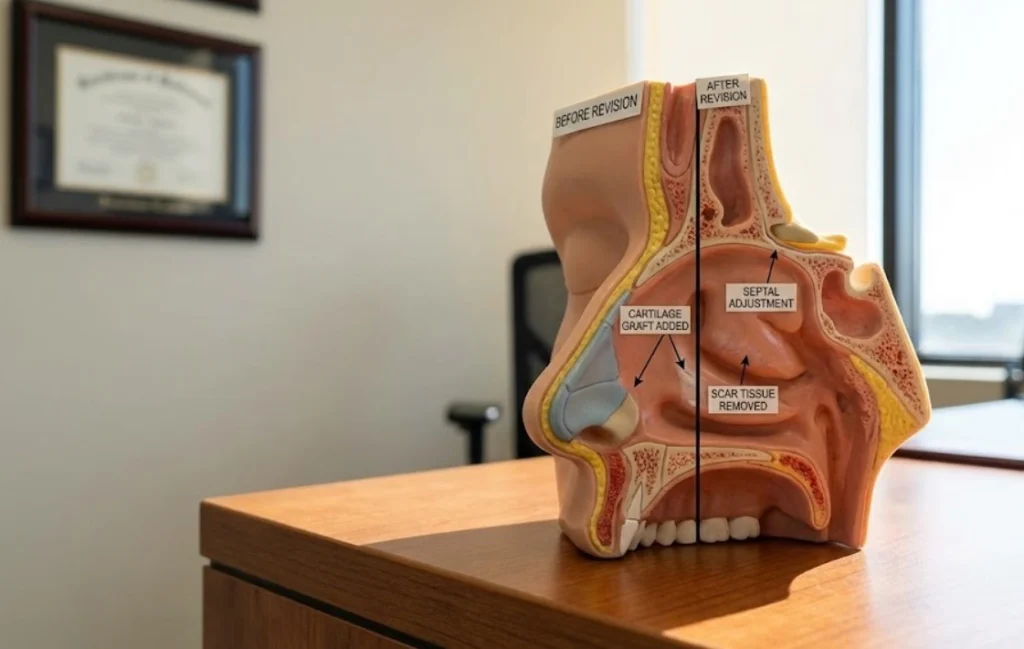
We must realize what kind of “wasteland” this surgery is before we can talk about the risk factor. A primary rhinoplasty is building a house on a clean, empty lot. The ground is level, the soil is fresh, and the materials are brand new.
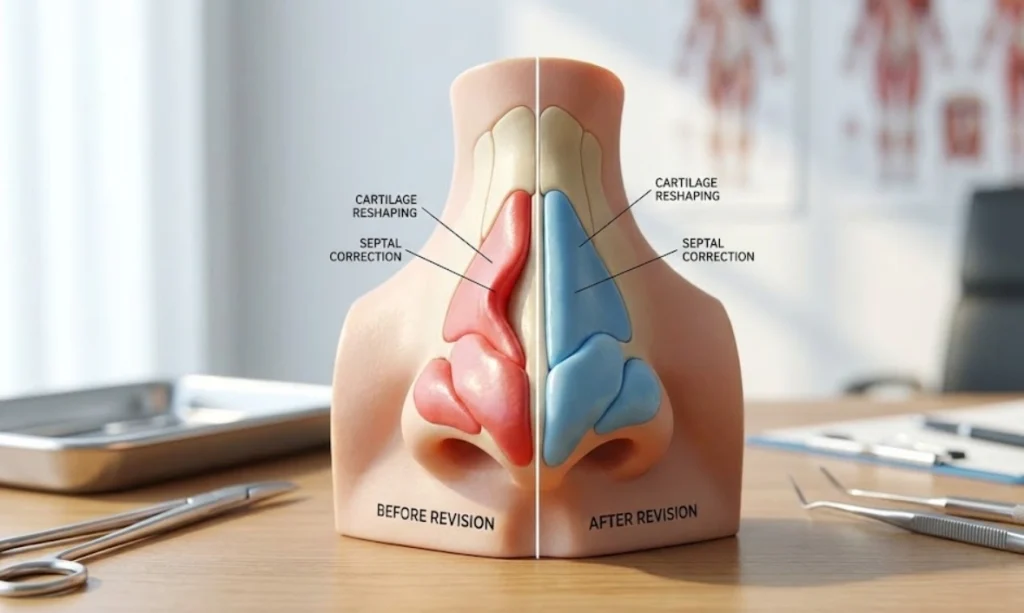
The first surgery is only half the battle – a revision rhinoplasty is similar to remodeling a house that has been partially demolished and rebuilt poorly.
- Scar Tissue (Fibrosis): The major foe of a revision is scar tissue. The healing response to the first surgery is that the body “glues” the skin down to the bone and cartilage. To separate the layers that are glued is very hard and one has to use extreme gentleness so as not to tear the skin.
- Distorted Anatomy: In a fresh nose, the surgeon’s knowledge about the position of the cartilage landmarks is absolute. In a revision, it is like trying to find a path in a forest which map has been torn apart. The surgeon can only rely on the fact that he/she is experienced and even then, there is no saying if all the obstacles will be successfully overcome.
The Shortage of Materials: Why We Need Ribs
Another issue brought on by revision rhinoplasty is running out of “building materials,” so to speak. Most times, the surgeon uses only one of the four septal cartilage pieces for the graft and tip support in a primary nose job. However, the previous surgeon has most likely already used up or damaged the septum in a revision.
We have to get materials from a different part of your bod…i… At Lin Europe Clinic, we often use costal cartilage (rib grafts). We make a tiny, discreet incision on the chest (usually in the breast crease for women) to remove a small piece of rib cartilage. Even though it might sound horror, this is more or less a standard procedure and the benefits part from merely being good are that rib cartilage provides a firm, strong, and straight support prop that is not only used for fixing a collapsed airway or a saddle nose deformity but is also in most cases insufficient when only ear cartilage is used.
The “Shrink Wrap” Effect and Skin Quality
The nose skin condition highly depends on the blood supply. It is one of the reasons why we try not to operate on the same nose too many times and when somehow it is inevitable, we take care of the vascular network during the surgery as much as the time allows. The risk of necrosis and skin loss is seriously increased in the case of a third or a fourth revision.
Besides that, the skin envelope in a revision patient is usually stiff and inelastic—we refer to this as the “shrink wrap” effect. The skin has contracted around the structure in the first surgery if it was made too small. Trying to bring the nose back to a normal size with the help of the skin is like punching with the hand put in a cast. That is why we ask patients to be patient for at least 12 months (sometimes even longer) between the surgeries. We want the skin to become soft again and the blood supply to be adequate before the surgical intervention is repeated. The most significant risk to the surgical wound when the revision rhinoplasty is rushed is the skin.
Breathing Issues: More Than Just Cosmetic
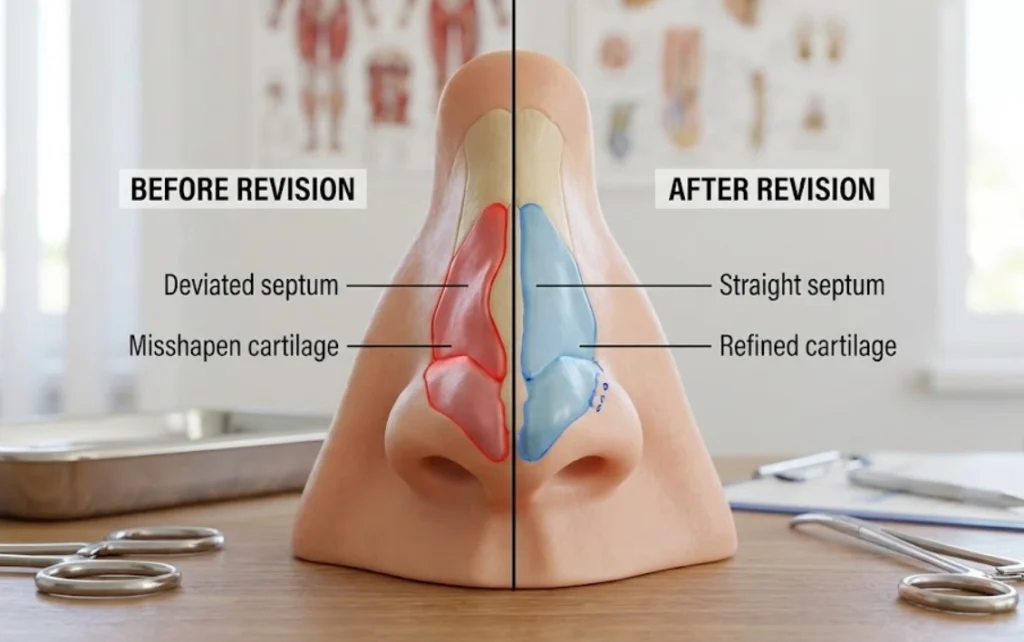
Some patients coming for a revision are not only dissatisfied with their faces but also find it extremely difficult to breathe. One of the common risks of aggressive primary rhinoplasty is nasal valve collapse, i.e. when the nostrils get pinched and you are prevented from inhaling deeply.
It is usual that a revision is a functional surgery. It is often a struggle to open the nasal valves and strengthen the sidewalls of the nose with the help of structural grafts. The work that the surgeon has to perform is doubled: he/she must meet the patient’s wish for a “small” nose and, at the same time, the “strong” nose that can function properly.
Why Turkey is a Global Revision Hub
The question is, why revision patients flock to Istanbul? The answer is simple: the quantity of surgical operations and the level of experience. Since Turkey is the world’s leading city for rhinoplasty, performing tens of thousands of cases annually, the frequency of complicated cases and the occurrence of severe deformities is naturally much higher in Turkish surgeons’ daily practice than in surgeons elsewhere who are only doing a few noses a month.
Not only aesthetic doctors but also reconstructive experts of Lin Europe Clinic are skilled in harvesting rib grafts and managing severe scarring. Your nose can be completely rebuilt from the ground up after the use of Structural Rhinoplasty procedures, which the surgeons at Lin Europe Clinic are proficient in. This ensures that you won’t need another surgery.
Frequently Asked Questions About Revision Rhinoplasty
Since revision rhinoplasty deals with dense scar tissue and altered anatomy, it is a riskier procedure than primary surgery. These factors make the procedure more technically challenging while the healing process becomes less predictable.
The longer duration of the procedure (often 4 to 5 hours) and the requirement of advanced surgical skills to rebuild the nose, which may include complex cartilage harvesting from the rib, are the reasons why revision rhinoplasty is more expensive.
Swelling after revision rhinoplasty remains quite significantly longer than after a primary surgery. Most of the time, it takes 12 to 18 months for the final shape to completely resolve and for the skin to settle again.
In case the septal cartilage has been removed or damaged and is no longer available for the first surgery, a rib graft is hardly ever omitted in revision rhinoplasty to provide the strong structural support needed to rebuild the bridge and tip.
In order to ensure a safe operation, you should give the scar tissue a year to soften and the blood supply to heal before having revision rhinoplasty after your last surgery.
Gunter, J. P., & Rohrich, R. J. (1987). External approach for secondary rhinoplasty. Plastic and Reconstructive Surgery.
Toriumi, D. M. (2006). New concepts in nasal tip contouring. Archives of Facial Plastic Surgery.
Foda, H. M. (2005). Rhinoplasty revisions. Facial Plastic Surgery.