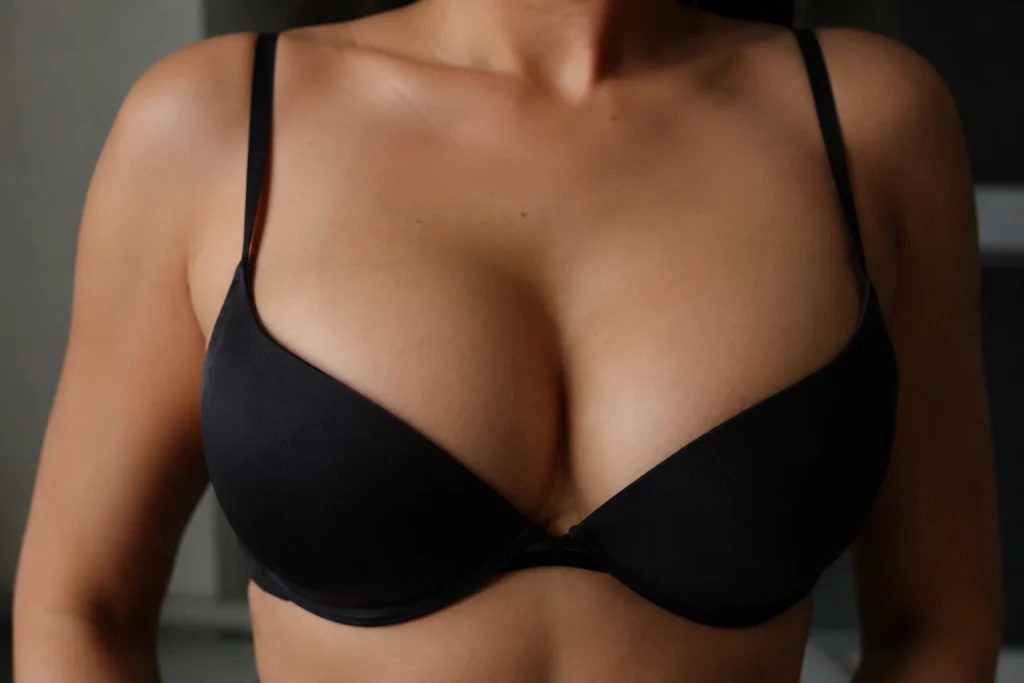
They can provide a more natural breast shape.
Realistic Shape and Natural Appearance
The decision whether teardrop implants are “more perfect” than round breast implants is totally patient-specific. They come with a sloped upper section and full lower section, so they look just like a natural breast. Therefore, the most subtle and natural-looking enhancement is a teardrop implant. From a purely technical point of view, teardrop implants are not “better”, but they are definitely best for ladies with minimal native breast tissue or a flat chest wall or who have suffered a chest wall injury (breast asymmetry). As they don’t have the glandular tissue on top in such ladies that would help in camouflaging the sharp top edge of a round implant, a teardrop-shaped implant with a sloped pre-made structure would prevent a very unnatural and noticeable “shelf” line at the collarbone area. For ladies who already, at least to a moderate extent, have breast tissue or who really want, not only a big-looking pair, but a large-looking pair, the most classic round implants are always a superior and reliable choice.
Mechanical Hazards and The Bonding Issue
The asymmetric shape of teardrop implants is the basis for the possibility of an anatomical implant rotating within the tissue. Round Implants are perfectly even, so even if they move just a little within the skin over the years, it would not really matter. On the other side, if the shape of a teardrop implant gets shifted or flipped, the bottom full portion that was supposed to go out of the upper breast would be stuck inside the breast, making visible the distortion. One would have to operate again, as there is no alternative but to get it sorted if one desires to continue wearing the beautiful outfit without getting attention in the wrong way.
As it would prevent such a kind of turning, makers developed teardrop implants with ultra-textured silicone covers that really function more or less like the skin of a glove with grip against the body of the human host. This texture creates a strong hold between the skin and the implant such that the implant doesn’t shift at all during the healing period. However, this tight texturing leads to heavy scarring of the internal pocket that makes surgeries done afterward a bit more difficult since it’s a bit of a hassle having to disengage the tissue that had become glued to the implant.
Surgical Insert and Pocket Creation
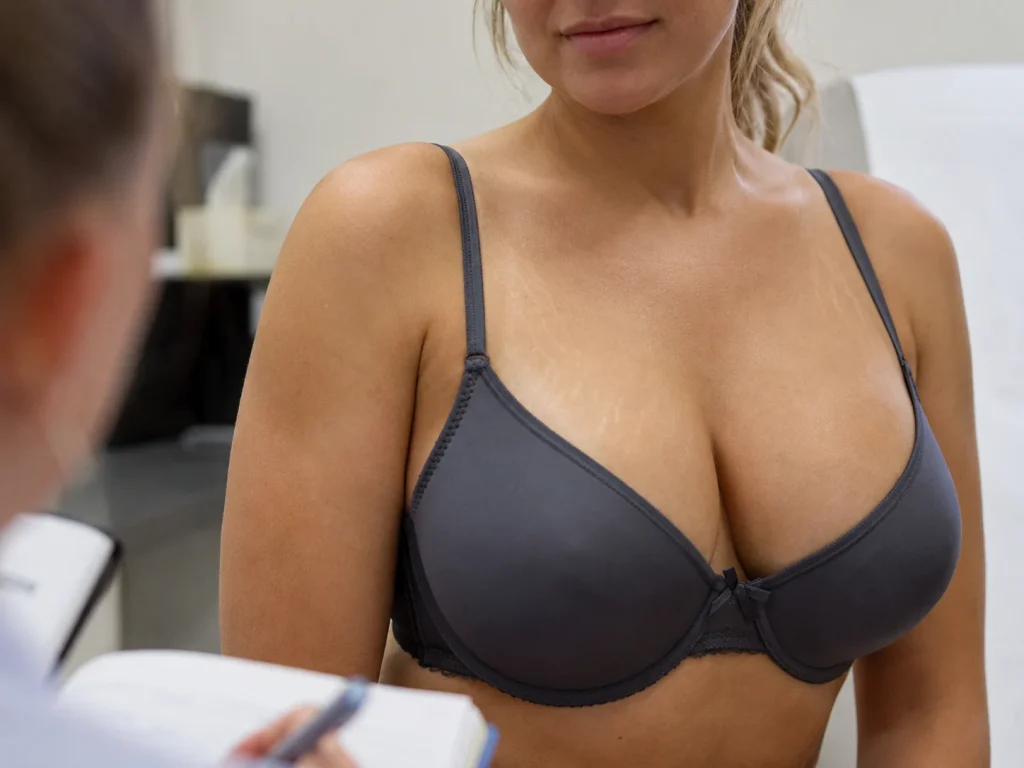
The form of the implants of this type has very special implications for the surgeon, as the surgeon would have to follow specific surgical procedures and be very careful choosing the incisions. These implants are made of highly rigid “non-foldable” silicone gel, which gives great resistance to gravitational forces. Hence, to safely insert such implants through very small wound sites, the surgeon has to make the incision longer than normal. These long incisions are normally created at the infra-mammary fold, where the visibility of the scar gets minimalized.
For a very accurate and flawless outcome with teardrop implants, a tiny mistake during the pocket separation cannot be afforded. As a matter of fact, the surgeon needs to carve the surgical pocket to the exact dimensions of the size of the implant so that the fit is just right, tight, and secure enough that it won’t allow for any rotational shifting after the surgery. So he needs to be a clinical wizard as well as have very sharp spatial perception. The surgeon also has to make sure that the implants are properly aligned against the chest wall while the chest wall is left in its most normal, least disturbed state as is, to reflect the fine, delicate, natural shape of a teardrop.
Structural Integrity and After Surgery Care
Strictly following the post-operative regime that is both protective and a bit restrictive is very important for people who want a really top-notch body profile out of their surgery. The breast pocket in which the implant goes, the implant itself, and the tissue gluing inside can be considered as living organs whose only way of getting a firm structure is through the mechanical protection given to it during the initial 6 to 8 critical weeks after surgery. Since tissue bonding to the implant is essentially the means of locking teardrop implants, making the upper half stay still in order to avoid rotation is even more important with teardrops in addition to round ones.
To make sure that your breast augmentation results are fixed into the desired shape in the most structurally accurate way, it is advised that during the recovery period from the surgery, you don’t partake in high-contact sports, do not run, and avoid heavy lifting that includes the upper body. Also, for the prevention of pressure and for limiting deep post-operative swelling, you need to sleep on your back with your body slightly raised. Also, you may need to wear an exclusive surgical-grade support bra the entire day for four months if not five so that the body doesn’t shift at any time while tissues are healing. Moreover, it will prevent you from using the most important healing agent, which is nicotine, because otherwise tissues can be starved of blood supplies.
Breast Implants in Turkey
LIN Europe Clinic Turkey offers the services that help you change your entire face shape, get a more defined and proportioned body, and perform the needed cosmetic changes with professional skill and a human touch. The very complex steps in surgery are very difficult to execute even for a master surgeon, and this surgery is about finding the best implant, the right shape, the appropriate volume, the right implant brand, as well as the right pocket dissection and the most suitable tissue adhesive, which is just the beginning of this journey towards an ideal breast. We can only help those who are prepared to go this long a distance with us, as it is not an aesthetic improvement at all that the patient seeks, but a total transformation of their personality through a major lifestyle change.
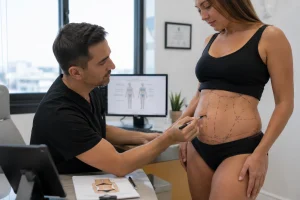
Making a long-term commitment to the work of the professionals and the medical team of LIN Europe Clinic, you will get the right structural diagnosis done and then a detailed mapping of your body that is in such a state as the pre-op planning is usually done at very short notices and with minimum time and effort on the part of the surgeon, as well as the availability of the equipment and the environment that the surgery is to be done will not always be the same and the results of the surgery can differ.
FAQ:
They are definitely not the superior choice for everyone because round ones might still be perfect for your type with a small amount of natural chest tissue. The idea is that if you want the breast profile that you see in the mirror, but don’t mind having the fuller look from round breasts on your chest at the top part.
Definitely one of the pros of the teardrop implants is the natural look since their design matches the slope of the human breast with the narrow top and wide bottom areas. Therefore, in cases where your torso is flat, the round implants would make you appear to have a bulging torso, but the teardrop implants would look way more subtle and natural.
The main fear here is the implant rotation. They are a special kind of implant in that, being asymmetrical, flipping them around or rotating them a bit will distort the shape and will show a deformed shape immediately, and this is going to necessitate a repair operation if the breast becomes deformed from the rotation of the implant.
These implants are constructed from very strong “gummy bear” type silicone gel and, therefore, they keep the exact shape they come in. Though they do an excellent job of giving your breasts a normal human breast shape, they tend to be very firm when touched, especially if compared to traditional round silicone type of implants.
Teardrop implants are actually engineered for the purpose of limiting the amount of upper-pole fullness you get. If cleavage is what you’re after, round implants are the better and more obvious ones.
Tebbetts, J. B. (2001). Dual plane breast augmentation and anatomical implant dynamics: optimizing implant-soft-tissue relationships. Plastic and Reconstructive Surgery, 107(5), 1255-1272.
Spear, S. L. (2006). Surgical planning in breast augmentation: Managing anatomical rotation, textured shells, and teardrop stability. Clinics in Plastic Surgery, 33(4), 543-552.
Rohrich, R. J., et al. (2014). Advanced postoperative care, pocket dissection stability, and risk mitigation protocols in anatomical breast augmentation. Aesthetic Surgery Journal, 34(5), 587-595.