Natural shape, better coverage, and improved support.
The Anatomical Mastery of Dual Plane Placement
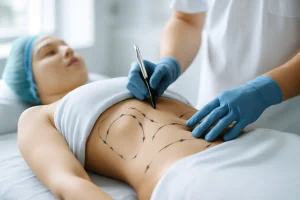
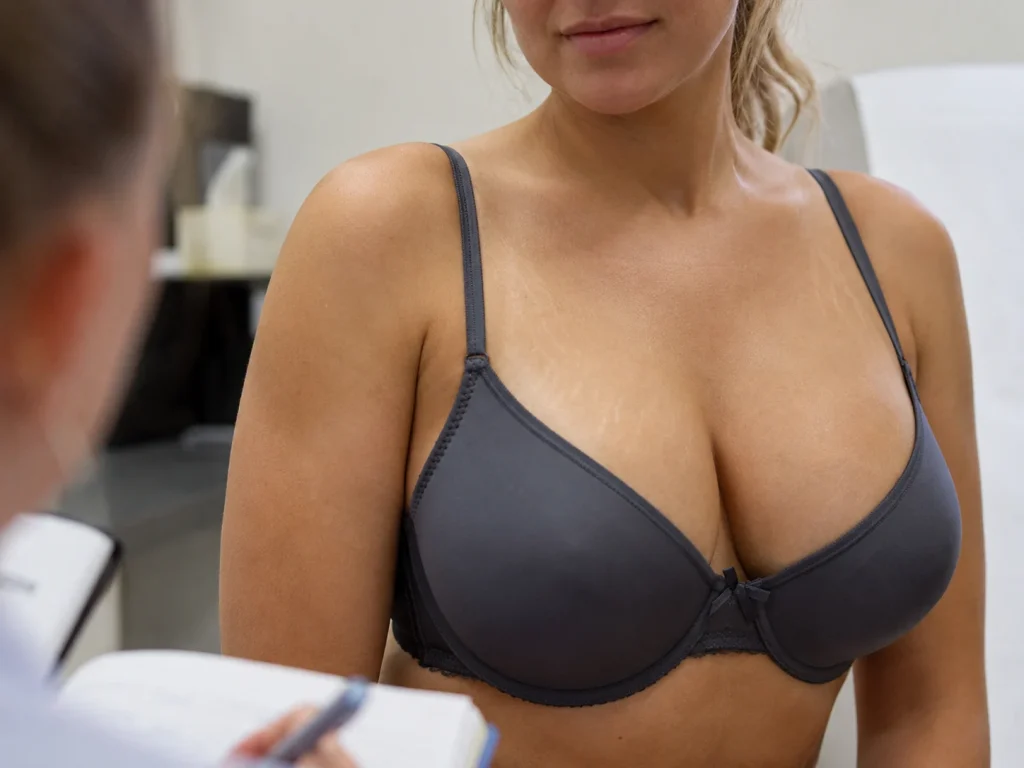
In the art of breast augmentation, the location of the pocket the implant goes into affects the final result. Dual-plane breast implants are considered the most advanced form of breast implant placement techniques today. These implants, part of the breast goes in under the muscle (the submuscular plane), part over the muscle (the subglandular plane). It brings together different advantages of submuscular and subglandular implant placement, resulting in aesthetically pleasing implantation of breast implants.
The biggest advantage of dual plane breast implants is the creation of a very natural-looking, “teardrop” shape, which is the same as your body’s movement. In this technique, the upper part of the implant is placed entirely beneath the pectoralis major muscle (your chest muscle), and the lower part of the implant is positioned directly behind the existing breast tissue (breast gland). This unique positioning makes the upper edge of the breast very soft while keeping the lower pole open and natural.
Key Aesthetic and Biomechanical Advantages
To know why the dual plane method is the best one, you can look at the major changes this method brings you from the aesthetic standpoint to the physical performance of your breasts and their internal tissues. By placing approximately half of your implant below the chest muscle, the surgeon hides your implant’s top edge quite well. Thereby, you will not see the artificial, overly round “stuck-to-the-body” look, which was characteristic of older techniques. It gives you a nice and smooth transition from the collarbone to the nipple without a big bulge.
In terms of tissue mechanics, by letting the lower part of the implant be placed in the glandular breast tissue, you enable beautiful natural stretching of the lower part of your breast tissue. You will not encounter animation deformity in your breasts while using your pectoralis muscle for movements such as going to the gym, dancing, and even doing your house. This is a situation where your implant either flattens or distorts, or it pops your muscle. Instead of that, the dual plane technique leaves lower muscle attachments so you can experience your breasts move, waver, and settle in just the same way natural breasts that hadn’t been augmented would.
Mitigating Complication Risks and Capsular Contracture
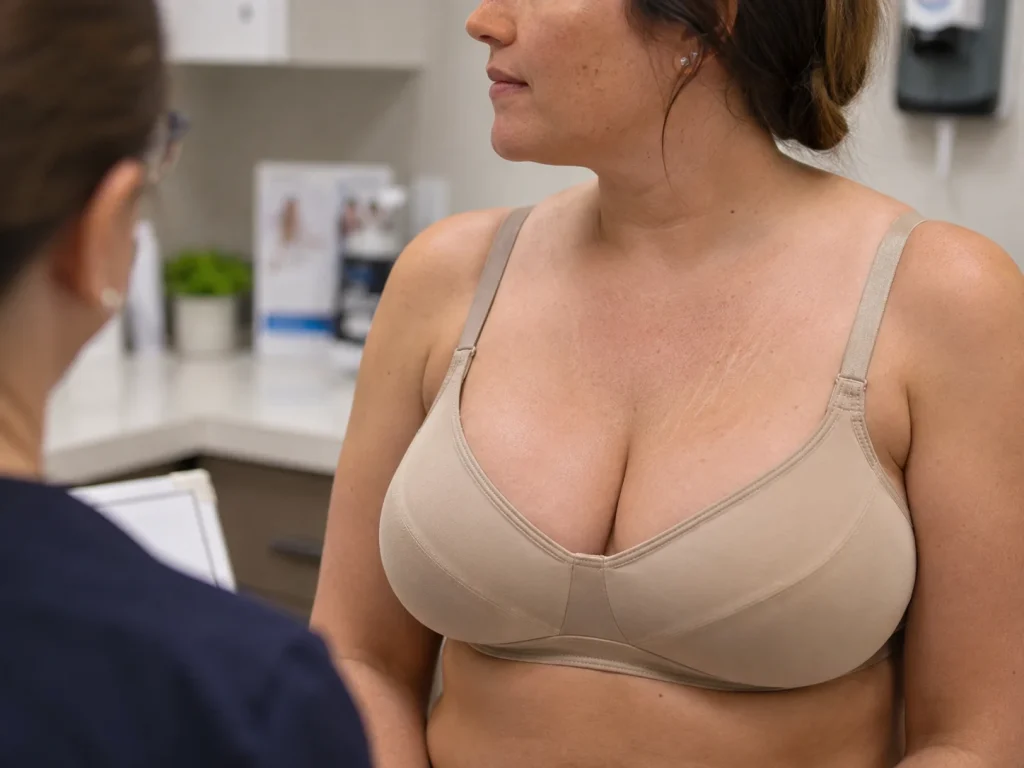
You will get much better-looking results not only from an appearance perspective, but also you will enjoy many health and safety benefits through the dual plane technique. Among the most common types of complications encountered in conventional breast implants is the development of a capsule made of the body’s own scar tissue, which gets contracted, thereby squeezing the implant. One of the major causes of the formation of hard, tight capsules is that the implant is kept static, but if part of the implant is lying underneath the muscle where the movements take place constantly, mechanical movements and internal “massage” are created. Scientific evidence supports that this method considerably reduces the formation of capsular contracture.
Furthermore, since dual plane placement provides you with another thick pad layer of muscles that lie between the implant and the skin surface, this soft cover is really helpful to prevent things like, the skin getting wrinkled (which you don’t see but is the rippling of the tissue beneath), feeling the implanted material under a layer of fat which is usually a problem, and the skin getting thinner with time. So even if a woman has naturally very little breast tissue or is of the slender build, it’s through this method that her implants will stay practically invisible both in looks and touch all through the wear time.
Preserving Structural Integrity and Post-Operative Boundaries
The first period of life with new breasts is a time when everything that can break is breaking, figuratively speaking. So the importance of following protective post-surgical rules if the patient sets extremely high standards for the outcome of the surgery is paramount. The newly created dual plane pocket, carefully placed implants, and the gentle handling of the muscles are all very delicate and will need the highest mechanical protection to develop strong collagen and fibrin bonds in the first important 6-8 weeks after surgery.
In order to have your newly contoured and lifted breasts stabilize as precisely as possible in their new shape, you must completely stay away from high-impact activities, such as running or heavy upper-body weight lifting, for the early stage of the recovery period. During the recovery phase, sleep is restricted to one’s back only, as well as having an upper torso that is raised, a posture intended to put the least stress on the healing tissues and to limit post-operative edema. Besides, continuous wearing for the first 4 to 6 weeks of a specialized medical-grade surgical support bra will provide mechanical support and support healing of surgical scars, besides preventing drag of tissues and tissue retraction.
Breast Implants in Turkey
Selecting LIN Europe Clinic for your aesthetic enhancement, body contouring, and surgical procedures means that you are stepping into a luxury health and medical paradise where our highly trained professionals will manage you with great care and a deep understanding of your needs. With us, you will be guided through each surgical step, and you will know exactly what we will have to do for you. We are aware that the perfect breast augmentation needs a very sophisticated technique to create the dual-plane dissections, implant profile vectors, and muscle changes that are not visible from the outside. We want to work in a transparent environment with an evidence-based medicine approach and high patient care standards that will be a pleasure for both us and for us.
In choosing LIN Europe Clinic in Istanbul, you will have at your disposal a team of highly dedicated specialists who can make the best possible use of your unique anatomy and provide you with top-level patient care while monitoring your physical condition so that your health status is diagnosed accurately, comprehensively, and professionally. You are offered a full range of personalized pre-operative mapping, tissue analysis in detail, tailor-made recovery instructions to make your whole post-operative phase a smooth transition, and you will be helped with a healing checklist that guides you through every stage of maturation of your implant tissue and changes to your lifestyle and habits after surgery.
FAQ:
The dual plane method simply means that the breast implant is placed partly under the chest muscle (top layer) and partly under the breast gland (bottom layer). It is another technique rather than completely putting the implant under or over the muscle.
The benefits are, for example, a very natural upper slope of the breast, the implant edges are concealed so there is no visible line, and the implant shape is soft with a teardrop shape rather than round and very unnatural.
Since this surgery partially releases the muscle and lifts the pectoralis, one would expect muscle soreness and tightness that generally lasts 3 to 5 days. However, that pain is like having done a very tough chest workout.
Actually, dual plane is widely respected as the best method to look natural with the breasts. By positioning the implant’s upper corner under the muscle, there wouldn’t be a fake and very round “stuck-on” look.
The fact that the pectoralis muscle contracts and relaxes over the upper half of the implant serves as an internal “massage,” and the formation of the very hard, contracting scar tissue is reduced.
Tebbetts, J. B. (2001). Dual plane breast augmentation: optimizing implant-soft-tissue relationships in a wide range of breast types. Plastic and Reconstructive Surgery, 107(5), 1255-1272.
Spear, S. L. (2006). Surgical planning in breast augmentation: Managing narrow base widths, tight skin envelopes, and dual plane stability. Clinics in Plastic Surgery, 33(4), 543-552.
Rohrich, R. J., et al. (2014). Advanced postoperative care, deep pocket dissection stability, and soft-tissue mitigation protocols in breast augmentation. Aesthetic Surgery Journal, 34(5), 587-595.