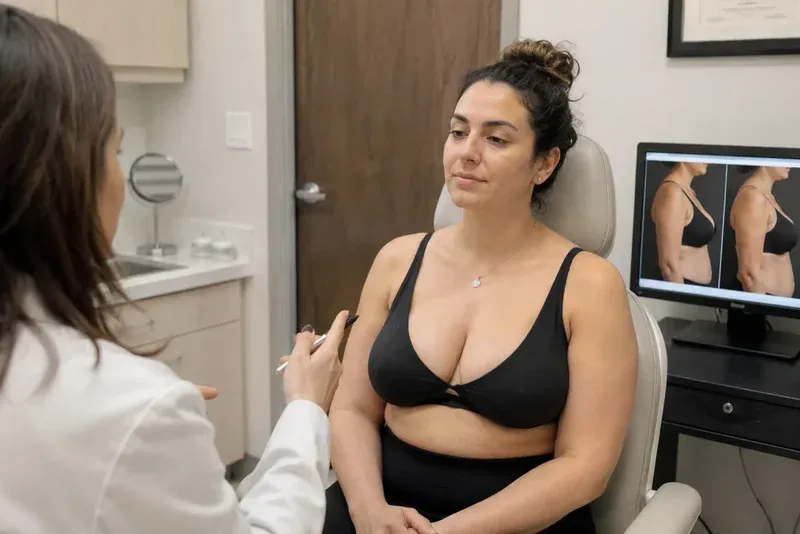
Yes, temporary asymmetry is common during healing.
Initially Post-Operative Tissue Asymmetry: The Truth
In the highly specialized field of aesthetic and revision breast surgery, keeping track of the geometric alignment and balance of your bustline during the recovery cycle is done from a strict anatomical point of view. After a structural breast reduction (reduction mammaplasty), you finding that your breasts look uneven or asymmetric during the first few weeks is completely normal and expected.
A breast reduction is a complicated architectural operation that requires the highly precise removal of excess glandular tissue, fatty tissue, and skin, as well as the vertical movement of the nipple-areola complex (NAC). Since each breast is considered an individual surgical site, your tissues will, in fact, react to this surgical trauma with different inflammatory phases. The main cause of early unevenness is local swelling (edema) and fluid accumulating asymmetrically, which hardly ever dissipates at the same rate on both sides of your chest.
The Healing Process Asymmetry-Age
Figuring out why the healing of one breast happens faster than the other is a matter of analyzing the different mechanical and biological factors involved in your recovery:
- Pre-existing Asymmetry: Almost all people have some level of asymmetry in their chest wall, rib cage, or tissue volume before surgery. The plastic surgeon adjusts the amount of tissue removal to these imbalances, but the breast contour after surgery is dependent on the anatomical foundations underlying the breasts.
- Different Surgical Explorations: In most cases, surgery is not performed equally in the breast areas; the surgeon may remove more tissue and fat from one breast than from the other in order to obtain overall symmetry in the end. For example, a greater volume of tissue is removed from the right breast than from the left, generating completely different internal wound sites, which result is different levels of swelling and skin tension.
- The “Bottoming Out” and Settling Phase: It is normal for the breasts that have just undergone reduction to be in a state referred to as “fluffing,” in which the breast tissue naturally hangs into the lower part of the skin envelope. This process has one breast that, quite often, begins to behave in this manner much earlier than the other, resulting in a temporary discrepancy in the level of projection and height.
How Your Body Shape And The Breast Tissue Support System Settle
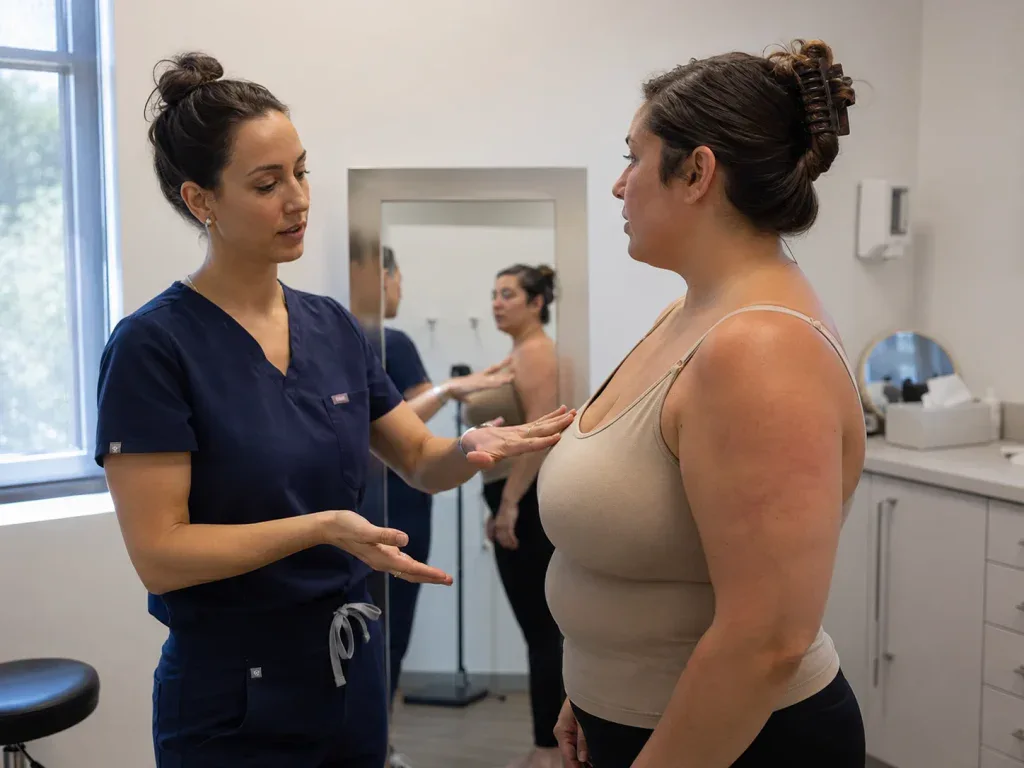
If you are a person with a very keen sense of discipline and order, who leads a highly ordered lifestyle and expects nothing but perfection from your body, then sticking to the post-operative instructions may be quite challenging for you, but also necessary and important. It goes without saying that a person very much devoted to having a well-shaped lower body, clearly defined core, and uncompromised hourglass figure nature will find it essential to support the changing upper torso, if not for structural survival, at least for physical satisfaction. On the other hand, heavy upper-body activities, or simply ignoring the compression rules, lead to severe biological consequences: skin and underlying tissues are under great tension, internal structural sutures may tear, swelling and fluid collection (seromas), or scar widening could ensue.
The specialized, wire-free post-surgical compression bra should be worn all the time and as directed in order for your reduced bust to stabilize with maximum structural accuracy and to achieve ideal symmetry. Also, you must completely avoid all heavy lifting, pushing, and high-impact cardio for at least four to six weeks. Besides that, totally eliminating nicotine and tobacco products is a must. Nicotine, as a strong systemic vasoconstrictor, narrows the micro-vessels leading to skin flaps and repositioned nipple pathways being starved of vital oxygenated blood almost instantly. Changing to a clean diet that is rich in protein will help in the repair of the deep dermal layers and will protect your results in the long run.
How to Differentiate Between Normal Settling and Surgical Anomalies
Having an accurate timetable of your tissue maturation will help you visualize your recovery path in a stress-free manner. The essential thing is to be able to distinguish fluid retention, which is a normal part of healing, from clinical problems that need doctor’s intervention:
- The Normal Maturation (Weeks 1–24) Stage: Changes in the breast contour, volume, or nipple position that resolve themselves with time. Softening of the tissues, settling of the breast shape, and harmonization of the final symmetry occur as the internal scars mature.
- Surgical Anomaly: A dramatic swelling of one breast accompanied by a very dark hematoma, extremely severe pain, or a tense hardness under the skin level during the very first days of the postoperative period. In addition, any localized heat, redness, spread of one area, or presence of very foul-smelling drainage coming from the incision line should be very alarming and warrant an emergency diagnosis by your clinical team.
Breast Reduction In Turkey
Going to LIN Europe Clinic means opening the doors of a world-class global medical oasis where your female breast concerns, complex structural remodeling, and surgical options are managed with impeccable clinical expertise and sincere, deep empathy. We understand that going through the exact recovery stages and anatomical changes after an advanced breast reduction needs a highly experienced and very well-facilitated environment that promotes evidence-based medicine at all times. Our medical facility, as a luxury establishment in Turkey, holds a strong position internationally in breast surgery and plastic surgery aftercare. It is a tranquil place where your health path is strictly regulated by global patient safety standards at the highest level.
Making a deep decision to entrust our team’s expertise at LIN Europe Clinic Istanbul to take care of your structural parameters will also give you a chance and opportunity to experience high-precision, comprehensive, personalized post-operative care, tissue-kinetics high-definition reviews, and customized healing guides, which will be your reliable assistant and guide through each stage of tissue maturation and lifestyle integration. Our highly capable medical professionals will make sure that your investment in body contouring and systemic health is fully safeguarded while giving you the opportunity to relax into your desired silhouette with complete calmness and confidence. Come to LIN Europe Clinic for exceptional and thorough medical care and make the most of the masterfully balanced canvas that is delivered to you safely fand masterfully in the center of Turkey.
FAQ:
Absolutely, it’s totally normal. The early difference in size is mostly the result of one breast swelling more or retaining fluid, which changes the look of the two surgical sites. This kind of asymmetry goes away as you heal.
Initial swelling subsides within 6 weeks, however, it takes 3 to 6 months for the breasts to completely soften, assume their natural shape (“fluff”), and to unveil their final symmetrical proportions.
Usually, the surgical team surgically removes different amounts of tissue from each side to correct pre-existing asymmetry that is why the size of the internal wounds is different and the speed of swelling clearance also varies.
Certainly wearing your post-surgical surgical bra as prescribed will be supporting the structural integrity uniformly while externally managing swelling and providing a framework for tissues to redrape evenly over your chest wall.
If a genuine volume or structural asymmetry remains after 6 to 12 months during the time when all internal tissues have fully matured, a small secondary touch-up or revision procedure can be considered to bring out your balance.
Kerrigan, C. L., et al. (2001). Reduction mammaplasty: Analyzing preoperative asymmetry, tissue excision protocols, and postoperative settling dynamics. Plastic and Reconstructive Surgery, 108(5), 1196-1204.
Hammond, D. C. (2009). Advanced short-scar breast reduction: Managing internal volume, asymmetry correction, and tissue tension standards. Clinics in Plastic Surgery, 36(1), 119-126.
Rohrich, R. J., et al. (2014). Long-term architectural stability, advanced garments, and soft-tissue optimization in revision breast surgery. Plastic and Reconstructive Surgery, 134(3), 356-365.