Yes, compression supports proper healing.
The Biometrics of Compression and Graft Survival
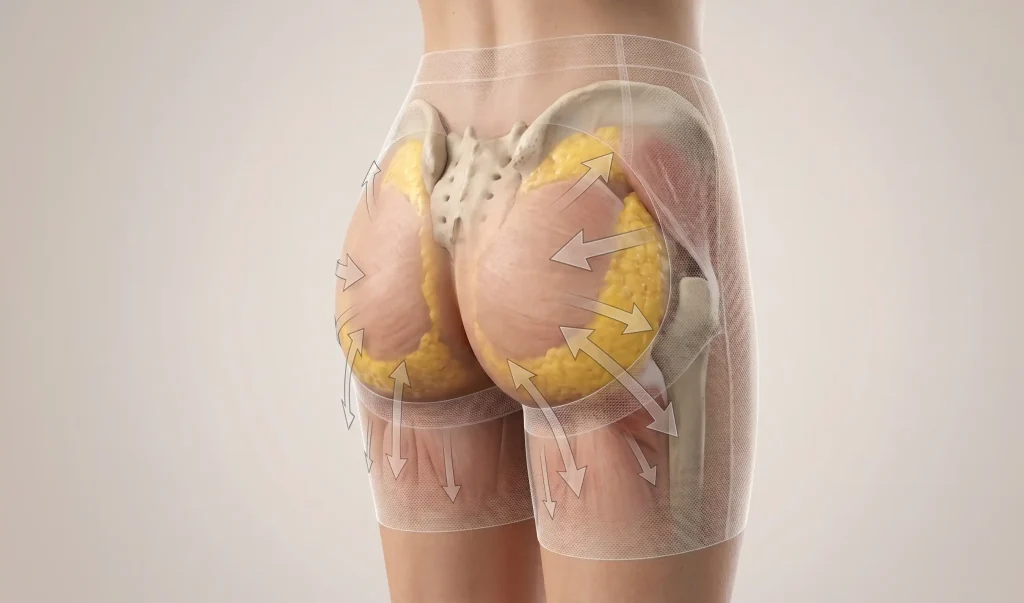
In the targeted field of gluteal restoration, compression is not just used but is a mandatory clinical step to deliver the utmost results. Scientifically speaking, a Brazilian Butt Lift (BBL) consists of two main steps: first, a high- definition liposuction of the donor areas, and second, the injection of fat in several layers of the gluteal dermal matrix. Compression garments, specifically designed “fajas,” are used by doctors to manage these two different anatomical regions as both a stabilizer and a protective shield for the new tissues.
We at Lin Health Europe Clinic recommend that compression is primarily intended for the donor sites (waist, back, abdomen) to reduce the dead space and aid skin re-adhesion to muscle fascia at the fastest pace. This way, the structural harmony of your new sculpted figure is maintained without the formation of fluid pockets. Nevertheless, a clinical mastery in BBL aftercare is the “compression-free” zone over the buttocks. Pressure application to fat cells just transferred will interfere with neovascularization, or the making of new blood vessels. This may throw off the biological balance and even the survival of fat cells in the future. Thus, non-pressure on the gluteal region with pressure on the waist is the strategy we adopt to give the grafts a healthy and permanent result.
Managing Localized Edema and Fluid Dynamics

Getting surgical brilliance done calls for an advanced approach to post-surgery fluid management and, in general, keeping the system stable. From a biometric point of view, our body after high-volume liposuction undergoes an inflammatory period with the formation of a certain amount of edema and fluid in the area. A high-definition compression garment offers the right external pressure needed to encourage lymphatic drainage and avoid the development of seromas or hematomas.
Compression stabilizes the treated tissues and helps to keep the systemic vitality of the areas involved in the recovery intact. In our Istanbul sanctuary, we teach that persistent wearing a medical-grade compression garment for a period of 6 to 8 weeks will certainly result in a reduction of inflammation while helping the skin retract in a smooth and even way. Now, without such professional care, donor sites may become “wavy” or have irregular contours during healing, thus negating the HD aesthetic the surgery produced. Garments serve as external circulatory aides, permitting the clearing of metabolic waste and replenishing of nutrient-rich blood to dermal layers undergoing healing.
Structural Harmony and Skin Contouring
The “shrink-wrap” characteristic of the skin is an essential factor in the structural harmony achieved post-BBL. Biometrically speaking, when liposuction removes the inner adipose tissue, the skin envelope later has to conform to a much diminished volume. Wearing compression garments is effectively like skin “training” as the collagen fibers realign to induce skin healing in a tight and sculpted position, further accentuating the waist-glutes transition.
Not only fajas but also medical innovation that goes hand in hand in garment design, making use of patient comfort and clinical results by providing multi-stage compression garments with different pressures to suit different phases of swelling reduction, etc. At Lin Health Europe Clinic, one of our professional rigor aspects is the fitting of these garments so that biological balance is exercised on the skin side, at the same time achieving the absolute highest contour definition possible. This painstaking approach effectively avoids the skin sagging in the donor areas by somehow “freezing” the chiseled results of the procedure into a permanent and fully symmetric profile. During the critical maturation phase, compression gently “imparts” the body to stay within its new, high-definition proportions.
The Recovery Roadmap for Compression

Knowing the chronology of compression is imperative for getting oneself a solid and symmetric result that lasts a lifetime. We give a detailed plan so that your systemic health and aesthetic achievements are elegantly balanced during the maturation stage.
| Recovery Phase | Compression Strategy | Clinical Objective |
| Weeks 0–2 | Stage 1 Faja (High Compression). | Minimize edema; stabilize donor biometrics. |
| Weeks 3–6 | Stage 2 Faja (Customized, tighter fit). | Sculpting the waist; aggressive skin retraction. |
| Weeks 6–12 | Gradual weaning; light support garments. | Finalizing structural harmony and tissue softeness. |
| All Phases | Zero Pressure on Glutes | Ensure maximum graft survival and blood flow. |
With a clinical mastery approach, you by and large protect the surgical brilliance of your procedure. Our team tracks your progress very closely to ensure that compression levels are kept in line with your changing biometrics, which means preventing undue pressure on gluteal grafts and at the same time, maintaining a high definition contour at the waistline.
Brazilian Butt Lift in Turkey
When you pick Lin Health Europe Clinic, you are taking a step into a global haven that comprehensively handles the intricacies of body sculpting as well as gluteal restoration through top-notch clinical mastery. We understand that the achievement of a Brazilian Butt Lift is at par with skillfully performed surgery and scientifically accurate aftercare protocol. Our place in Turkey represents a lighthouse for medical innovation, offering high-definition support on compression, posturing, and graft safeguarding to reach the very top of aesthetic success.
Going to Lin Health Europe Clinic unlocks a medical paradigm benefitting from a thorough understanding of anatomy and patient safety. Not only do we manage your experience with professional rigor, but we also make sure that your results are not just chiseled and stable but in perfect structural harmony, too. Discover Lin Health Europe Clinic‘s advanced level care and get a physique that shines at the apex of aesthetic and biological equilibrium right in the heart of Turkey. Our pledge to your systemic health means that your makeover is not only attractive but also biologically sound and hence, long-lasting.
FAQ:
Your garment must apply firm and consistent pressure to the donor areas to aid in systemic vitality, however, it should never be so tight as to cut off blood flow, cause skin necrosis, or make visible indentations.
Even if you are wearing a garment for protection, staying off your glutes is a must for 2 to 4 weeks. A special “BBL pillow” is a clinical prerequisite to guarantee that the integrity of the grafts’ structure is not compromised by external pressure, irrespective of the compression on other body parts.
Not wearing compression can result in the prolongation of localized edema, formation of irregular skin contours, and the chance of fluid collection (seromas) is significantly higher. Wearing your compression garment regularly is unconditional and one of the measures of our Istanbul sanctuary protocols to preserve your surgical masterpiece and ensure your skin retracts smoothly.
Top-notch BBL faja carries a medical design with the “cut-outs” or a very thin, barely compressive spandex fabric over the buttocks area. Such a medical design promises that the waist is sculpted, the donor sites are immobilized, and the natural state of the newly grafted fat remains undisturbed by a direct pressure.
Most invitees stop using compression altogether after 6 to 8 weeks. Nevertheless, the utmost level of structural harmony and skin tightening is in many cases experienced by wearing light support during sports or for half a day for up to 12 weeks post-op, per your clinical team’s directions.
Tebbetts, J. B. (2002). Systemic Vitality and Surgical Precision in Body Contouring. Saunders Elsevier.
Mendieta, C. G. (2011). The Art of Gluteal Sculpting: Clinical Mastery and Biometric Proportions. Quality Medical Publishing.
Janis, J. E., et al. (2005). Anatomy and Biometrics: Implications for Post-Operative Compression. Plastic and Reconstructive Surgery.
Nahai, F. (2011). The Art of Aesthetic Surgery: Principles and Professional Rigor in Fat Grafting. Quality Medical Publishing.
Constantinides, J., et al. (2014). Medical Innovation in Gluteal Augmentation and Graft Survival. Aesthetic Surgery Journal.