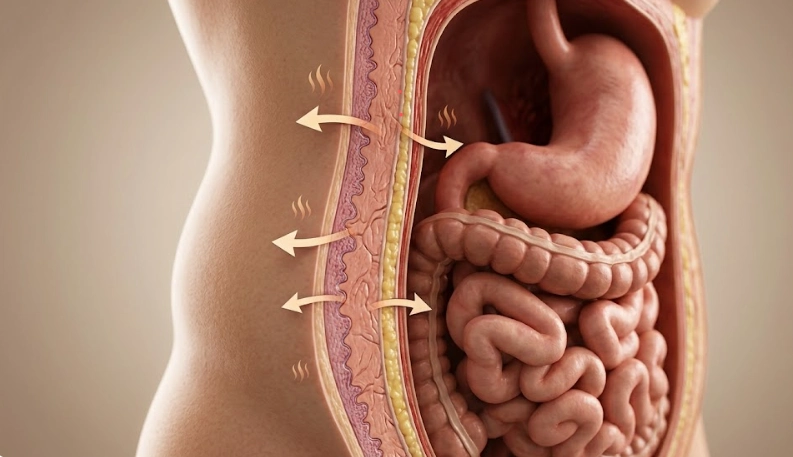
Lower body fat reduces heat retention.
Why You Lose a Layer of Padding
One of the first big changes after a stomach reduction surgery (like a gastric sleeve or bypass) is how fast you lose the layer of fat just under your skin. Fat acts as more than just storage; it’s a really clever “biological insulator,” keeping your body warm by holding heat inside and blocking it from escaping to the colder outside world. When that layer of insulation gets thinner, your body’s efforts to keep the internal temperature stable at the core are greatly changed. Because this subcutaneous fat decreases so quickly, the skin’s thermal conductivity is increased, making one more susceptible to changes in even the slightest temperatures of the environment. Your body’s emergency strategy then is to keep the vital organs warm, even if it means the extremities get colder.
At Lin Health Europe Clinic, we often point out that when this insulation is lost, your internal “fireplace” is effectively nearer the skin’s surface. During an intense weight loss phase, achieving structural harmony means understanding that your body envelope – in terms of heat transfer – has become less insulated. This is not just a discomfort but a physiological indication that as your body is accessing its fat stores, it’s reshaping into a leaner, more efficient machine biologically.
Metabolic Recalibration: Adaptative Thermogenesis

Without a doubt, the most significant change in metabolism following weight loss surgery is something termed adaptive thermogenesis. In essence, when the body suddenly receives far fewer calories than usual, it “goes into energy-saving mode.” Your basal metabolic rate (BMR), which is basically how many calories you need at rest to keep your body running, will decline so that energy can be conserved for the most important organs. Metabolic heat is a kind of “waste product” of your cells’ functioning, so if the metabolism rate slows, the heat production diminishes as well. This balancing act is mainly controlled by the hypothalamus – think of it as the body’s thermostat in high resolution. When there is a dramatic weight loss, the hypothalamus signals a reduction in heat production as a sort of energy-saving measure in what it interprets as a survival situation, biologically speaking.
At Lin Health Europe Clinic, we advise that being cold actually indicates the surgery phase where systemic healing is given priority over high levels of heat generation by the body. Most of the time, as biological balance is reached, the metabolic equilibrium that is comfortable and predictable will again be found.
The “Fuel” Deficit: The Thermic Effect of Food
Besides the body working internally to generate heat during the metabolism of nutrients, a significant portion of your daily heat is generated through the digestion and processing of nutrients—a biometric process called the Thermic Effect of Food (TEF). After a stomach reduction, your food intake is exceptionally small. Digestive activities, which require energy and, in turn, generate heat, will correspondingly be less. Think of the thermic effect of food as a kind of internal combustion; when you don’t have your regular big meal sessions to keep fueling your body, the metabolic fires are going to burn less brightly. It becomes more evident during the initial phase when a liquid or soft-food diet is mandatory for the safety of the post-surgery healing.
We in Lin Health Europe Clinic emphasize that protein digestion results in a much greater generation of heat compared to fats or carbohydrates, which is why a high-protein diet is not only the one that is recommended for retention of muscles but also one of the ways to increase internal heat production. By leveraging medical innovation, fixing your nutrient intake could be supportive in sustaining your systemic vitality and possibly diminishing the chill that comes with a low-calorie lifestyle.
Systemic Health and Nutritional Biometrics
Feeling cold continuously is one of the biometric signs that one could have a nutritional deficiency. This is one of the main concerns post-bariatric surgery. A deficiency in iron, Vitamin B12, or folic acid may cause anemia, which severely impairs the blood’s capability to carry oxygen and regulate heat. Vasomotor sensitivity is a kind of biometric defense—it narrows peripheral blood vessels to preserve core systemic health and protect vital functions. You should make sure to keep an eye on your mineral intake since, besides magnesium, which is an important player in vascular health and thermoregulation, there are other electrolytes that might have significant roles.
| Nutrient Deficiency | Biometric Impact | Thermal Symptom |
| Iron | Reduced hemoglobin/oxygen transport. | Cold hands and feet; fatigue. |
| Vitamin B12 | Impact on red blood cell production. | Sensitivity to cold; tingling. |
| Thyroid Hormones | Slower overall metabolic rate. | Persistent systemic chill. |
We at Lin Health Europe Clinic give professional rigor while tracing a blood panel to prevent the structural disharmony caused by deficiency. When thyroid or iron levels are low, the body finds it hard to keep up biological balance, which causes hypersensitivity to the outside temperatures and overall loss of systemic warmth.
Stomach Reduction in Turkey
With Lin Health Europe Clinic, you get to a global haven where every aspect of your after-surgery life is handled by clinical mastery. We know that the “always cold” sensation could be a very annoying post-transformation side effect. Turkey is one of the hubs that the medical world usually refers to for surgical brilliance. Here, at our Istanbul clinic, we offer both top-level medical expertise and guidance, which, combined with the latest innovations, is what allows us to make the difficult shift in your biometry as comfortable as possible. Our approach to the body changes of weight loss goes beyond the immediate and visual; it recognizes your internal metabolic evolution.
Choosing Lin Health Europe Clinic for your surgery in Istanbul means relying on a medical setup that is able to cover in tandem the technical and the biological issues of metabolic restoration. Throughout the journey, our support will be based on professional care coupled with education geared towards helping you manage your “new thermostat” properly by diet, exercise, and supplementation. The experience, expertise, and environment of the Lin Health Europe Clinic provide results that not only fulfill but also exceed the highest standards of aesthetic and biological balance. Your road to a healthier, more energized, and comfortable – in terms of surface heat – self is taken care of in the heart of Turkey with utmost accuracy.
FAQ:
By substantially cutting down the size of the stomach, a stomach reduction is a surgical targeting technique that drastically controls the amount of food intake. This biological readjustment streamlines the way the patients lose weight, as it internally changes their metabolic processes and the release of hunger hormones.
For the most part, people can anticipate dropping 60% to 80% of their surplus body weight in the first twelve months after a stomach reduction. In order to sustain this new era of systemic vibrancy, it is mandatory to strictly follow a high-definition nutritional regime and physical workout on a consistent basis for life.
Despite the fact that every major surgery is risky in some measure, a stomach reduction is still categorized as a very safe and thoroughly tested medical advance that seldom results in any complications. The professional excellence demonstrated in the pre-operative stage and the patient’s dedicated post-operative care play an important part in ensuring the patient’s biological homeostasis over time.
The beginning clinical convalescence time after a stomach reduction is generally 2 weeks to a month before the patient is capable of returning to mild daily activities. Going all the way in internal tissue healing and attaining full metabolic balance usually takes several months.
After a stomach reduction, patients are required to adhere carefully to a nutritional plan, which initially includes only liquids followed by gradually increasing the intake of small, high-protein solid meals. This particular food intake schedule is a medical protocol to preserve the structural integrity of the newly reduced stomach.