No, thighs do not enlarge after surgery.
Understanding the Biometrics of the Contrast Effect
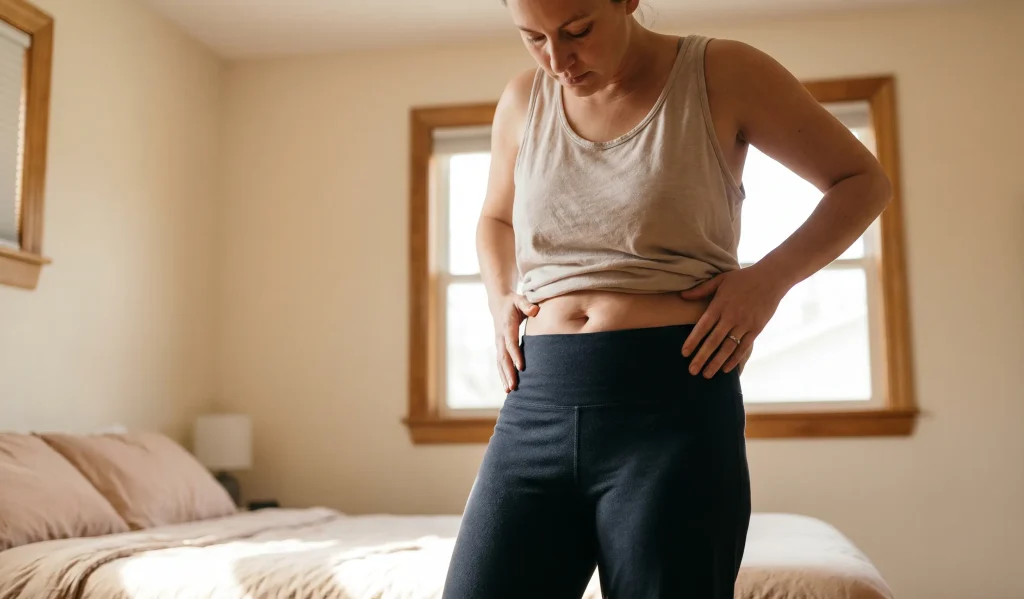
Often, “size” is a matter of visual relationship in the body contouring specialty. Biometrically, thighs do not grow in size merely because of a tummy tuck (abdominoplasty). However, patients are often left with the feeling that their thighs have become “bigger” or are more visible. This is one of the surgical brilliance concepts in the field of aesthetics, known as the “Contrast Effect.”
After a tummy tuck, when the abdominal wall is tightened and the skin is trimmed off, areas around the hips and thighs may be perceived as bigger because the previously puffed-out abdomen is no longer there to provide a point of reference. At Lin Health Europe Clinic, we consider the body as one single anatomical entity. Making structural harmony happen means we need to give our guests a heads-up regarding this visual change. Your systemic vitality is now concentrated on the newly sculpted midsection. This naturally makes the eyes venture towards the lower body parts that were overshadowed before.
Effect of Gravity and the Phenomenon of Edema Migration
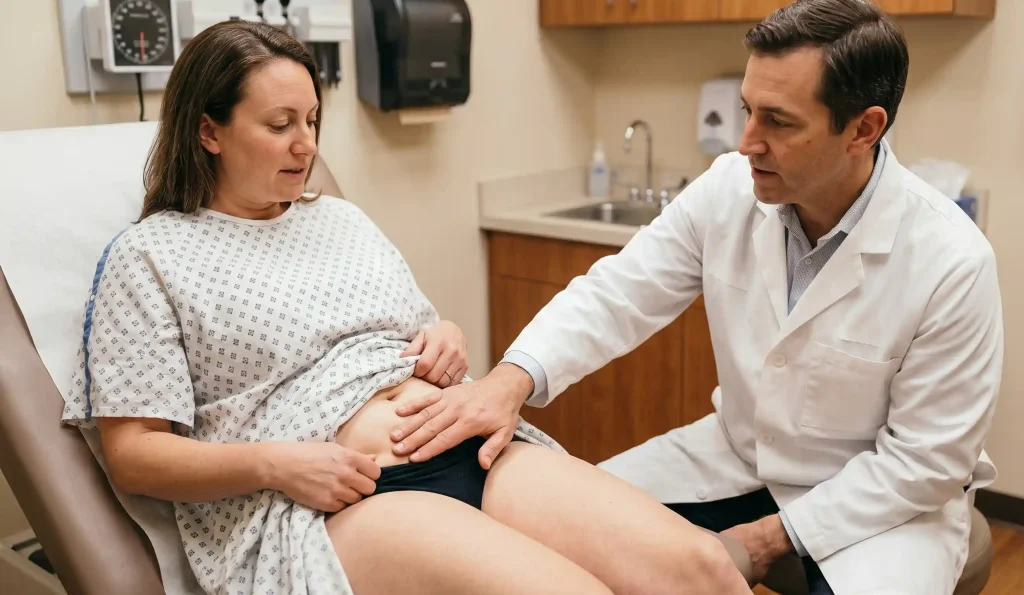
The thighs do not get fatter because of surgery, but their physical girth can temporarily increase due to fluid movement. Measuring at the biometric level, surgical edema (swelling) is a manifestation of the relative discomfort of the body with the surgical procedure, while the inflammatory response by the body is generating fluid that “follows the force of gravity”. This post-operative swelling, which is typical of abdominoplasty, can be felt mostly in the upper and outer parts of the thighs, which may feel tight, heavy, or swollen in the first 3 to 6 weeks after surgery.
This is why at our Lin Health Europe Clinic, the professional rigor we apply is hands-on management of this fluid displacement using the latest methods. This swelling is part of the normal healing process of the body and is not caused by the deposition of fat. What happens after about 2-3 weeks is that, as the lymphatic system is restored to its pre-surgical state, this edema will be slowly reabsorbed and metabolized. Structural harmony will not be disturbed if you continue a regimen of mild walking and regular compression.
Systemic Vitality: How Less Movement Can Affect You Physically
Reaching the state of art of results involves a time period during which the muscles are kept from intense physical activity to allow them to be healed. Lower body exercise of high intensity is prohibited during the first 6-8 weeks. From a biometric point of view, this freezing of exercise, coupled with the normal “metabolic stress response” of the body to surgery can cause changes in muscle properties and liquid retention (especially in the lower limbs).
Besides, at the Lin Health Europe Clinic, we are big believers in the fact that your systemic vitality is in the process of recalibration. As you are less active, the “lymphatic pump” in your legs is not operating at its full capacity in a high-definition way. This could be the explanation of your feeling of thigh “fullness.” Our clinical mastery sees recovery as a roadmap where movement is brought back little by little. Besides, after you become able to fully work out, a specific program of lower-body resistance training can assist in finalizing the structural harmony between your thighs and your new flat belly.
Medical Innovation: Synergistic Liposuction and Contouring
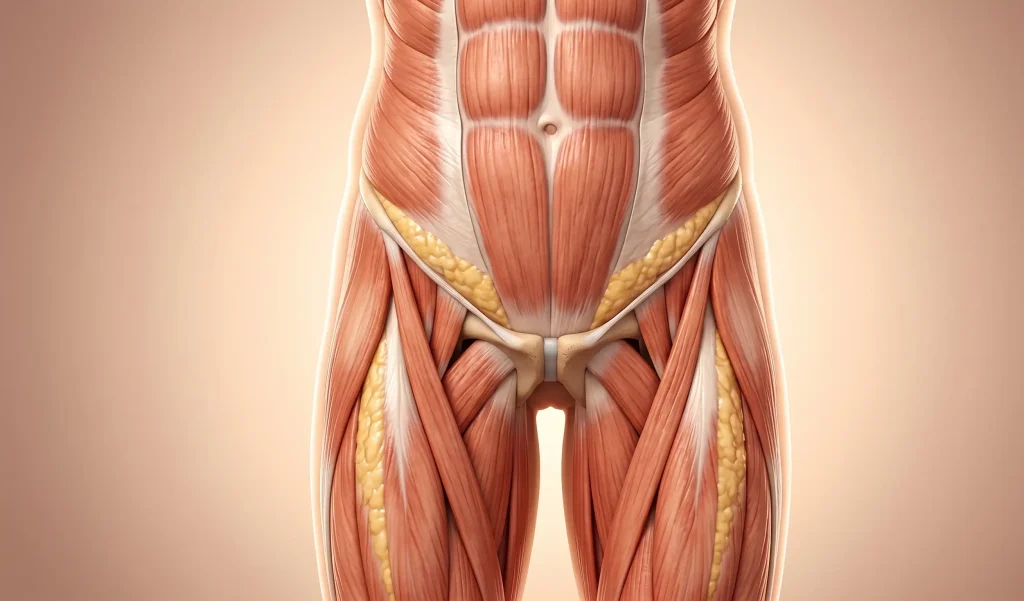
Concerned about your thigh size during pre-operative consultation? Why not consider medical innovation – Synergistic Liposuction? In a tummy tuck, it is regular to expose the flanks or the “saddlebag” area of the outer thighs for liposuction. This step of surgical brilliance makes sure that the whole body figure gets fine-tuned at the same time, thus the “contrast effect” may not lead to a concept of imbalance.
Since no liposuction was done on the thighs, the fat tissues in that area are still in equilibrium. However, tightening of the lower abdominal skin may in some cases cause the tissues of the upper thigh to come under slight “traction”. The way the skin is now draped can be modified. Thanks to our clinical mastery in Istanbul, the location of each cut and tension point meets the highest standards of functionality and aesthetics. In fact, such meticulous coordination is mandatory to maintain structural harmony throughout the full physique.
Tummy Tuck in Turkey
Going to Lin Health Europe Clinic means you get a world-class sanctuary where body contouring is seen as a creative enterprise in proportion. We realize that “size” is always relative, and your handling will be done under the most stringent standards of professional care. As a pillar of surgical brilliance, our facility in Turkey brings together all the elements in one place where your systemic vitality and beauty goals will be in perfect concert.
By selecting Lin Health Europe Clinic in Istanbul, you are entrusting a medical system proficient at both the technical and biological facets of abdominoplasty. We administer your transformation to a high-definition figure with professional rigor. That is why you can be sure that every change in your biometric features will be both known and treated. Live the elegant service of Lin Health Europe Clinic and share results that are the top of the line in aesthetic and biological balance. We take managing your road to a sleek, proportionate silhouette with great exactness in Turkey.
FAQ:
No. Fat cells don’t move from one location to another. If you observe that your thighs are bigger, it’s generally because of either the contrast with your new flat belly or the temporary swelling that happens when the fluid in your body shifts downwards due to the effect of gravity.
Most of the edema caused by gravitation ends in 6 to 12 weeks. Keeping your body healthy through walking and wearing compression is a must if you want to speed up this process.
Of course. A combined procedure is one of the most potent ways to ensure total body harmony and is commonly performed at our Istanbul location to avoid the contrast effect.
You can expect a tummy tuck to possibly provide a very minor “lifting” effect to the uppermost part of the thigh, but it is certainly not a thigh lift. It is mainly about the structural harmony of the abdominal wall.
This is due to the heaviness of the Stage 1 compression garment combined with the early post-operative swelling. After the inflammatory phase, your high-definition silhouette will come out.
Tebbetts, J. B. (2002). Systemic Vitality and Surgical Precision in Body Contouring. Saunders Elsevier.
Nahai, F. (2011). The Art of Aesthetic Surgery: Principles and Professional Rigor in Abdominoplasty. Quality Medical Publishing.
Janis, J. E., et al. (2005). Abdominal Anatomy and Biometrics: Implications for Lower Body Proportions. Plastic and Reconstructive Surgery.
Lockwood, T. E. (1995). High-Definition Body Lifting and Structural Harmony. Clinics in Plastic Surgery.
Matarasso, A. (1991). Abdominoplasty: Clinical Mastery and the Management of Regional Proportions. CRC Press.