
Biometric Relation Of Silicone Toxicity With BII
In the exclusive field of breast surgery, it is necessary to know the difference between the patient-reported condition of Breast Implant Illness (BII) and the biological hypothesis of silicone toxicity. Although these two terms are often confused and mixed among patients, they reflect completely different medical views. In fact, BII serves as a “catch-all term” indicating various systemic symptoms, such as fatigue or memory issues, that people with breast implants usually complain of. On the other hand, silicone toxicity is usually limited to the body’s chemical or immune response against silicone particles, e.g., in case of implant rupture or “gel bleed”. It is only by making this distinction that one can aim at the overall balance and purposefully plan efficient therapy for the patient.
At Lin Health Europe Clinic, this difference, whether big or small, is accurately recognized and understood at the deepest clinical level. Our experts in Istanbul, with the help of sophisticated assessment techniques, ascertain whether a patient’s symptoms pertain to a localized reaction to the implant or a systemic whole-body condition so that the treatment plan can rely on the systemic health of the patient.
BII As An Umbrella Term For Clinical Symptoms
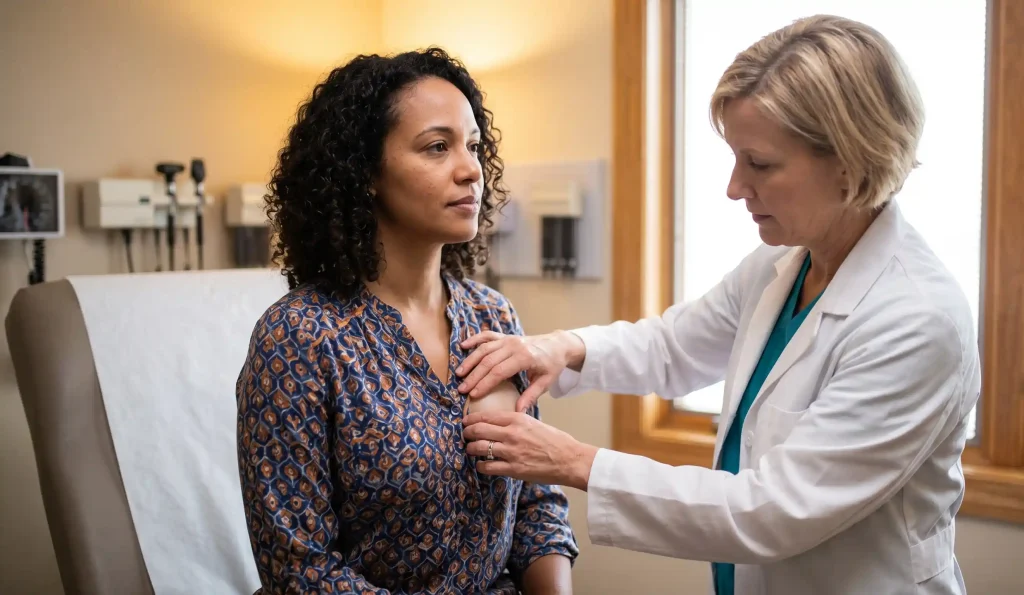
Breast Implant Illness or BII is a term currently used by a number of patients to indicate a set of multi-systemic symptoms which they link to their breast implants, whether made of silicone or saline. From the viewpoint of biometry, BII cannot not capable of being diagnosed by a single test, and it lacks a universally accepted medical definition. Therefore, it is usually a “diagnosis of exclusion”. Patients typically experience a large number of symptoms, such as joint pain, hair loss, and respiratory problems, that are commonly attributed to a person’s immune system reacting unfavorably to a foreign body in their organism. Since the shell of both the silicone and saline implants is made of silicone, BII is associated with a wide range of biologic reactions in the breast tissue.
At Lin Health Europe Clinic, we bring a high level of professionalism to our work with tailored, comprehensive tests for BII-affected patients. Our medical team in Turkey is extremely talented not only with surgical procedures but also with the diagnostic aspect, as they take thorough histories, offer a medical setting where patients can be comfortable while describing these complicated and non-specific symptoms, and then, with absolute professional care, attend to these symptoms.
Mechanisms Of SILICONE Toxicity And Gel Bleed
Silicone toxicity deals precisely with the chemical and biological effects of the silicone particles on the body’s internal environment. It is possible that even if the breast implant is intact, the process called “gel bleed” can result in the release of microscopic silicone molecules, which can cross the shell and interact with the surrounding tissue. Usually, the biometric properties of these particles make these silicone molecules recognizable by the immune system as adjuvants. Consequently, this may lead to a chronic inflammatory condition or Autoimmune Syndrome Induced by Adjuvants (ASIA). The emphasis on the incompatibility and toxicity of this material is developed in this theory alone, contrary to the broad version of BII that is symptom-based, and it views mainly the implant-capsule interface for restoring the structural harmony of the tissue.
Apart from the safe and effective treatment of BII, we at Lin Health Europe Clinic are very keen on the holistic assessment of implant condition in our Istanbul facility. Our medical specialists are extremely proficient in recognizing the slight biometric indicators of gel bleed and localized silicone migration, resorting to state-of-the-art imaging techniques so that the patient’s systemic well-being is not undermined.
Common Symptoms And The Overall Condition Of The Body
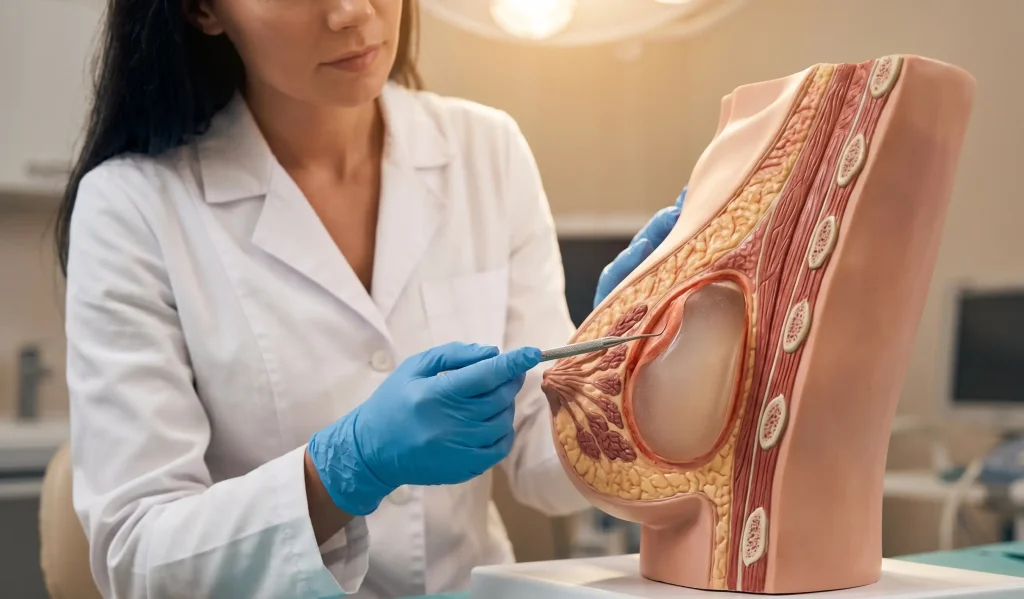
Even though the different definitions set silicone toxicity and BII apart, in reality, these two conditions biometrically overlap a great deal in the way they disrupt a person’s systemic vitality. One of their common features is that they give rise to chronic inflammatory triggers that can cause the body’s natural detoxification pathways to become exhausted. This explains why patients experience symptoms such as severe fatigue, “brain fog,” and skin sensitivity. It does not matter whether the trigger is a direct chemical/toxic effect of silicone molecules or the immune system attacking a foreign object (BII); in either case, the outcome will be the loss of the body’s structural harmony and the lowering of one’s ability to function each day. It is very important to detect these overlaps as early as possible so that the patient can restore their biological and aesthetic balance.
We never slacken in performing surgical brilliance. Every patient at our center in Istanbul is regularly observed for signs indicating these overlapping clinical issues. We always put the preservation of healthy tissue biology first so that your convalescence will be under the most stringent technical and clinical supervision possible and you will be able to regain your systemic health in Turkey.
Breast Implants in Turkey
Dealing with the issues of BII and silicone toxicity at Lin Health Europe Clinic is effectively a way to self-renew. Our center is in Turkey, and it is equipped with all the features of a global resort where surgical brilliance is combined with safety on the level of JCI accreditation, representing a rare and exquisite environment for those in pursuit of solutions and healing. We know that it makes no difference whether you explain and label your symptoms as BII or silicone toxicity; you end up wanting the same thing: to restore your body’s structural harmony and maintain your long-term health and wellness. We offer a completely integrated and seamless paradise where your apprehensions will be acknowledged and handled with state-of-the-art equipment and by thoroughly trained professionals.
By making the choice to visit our Istanbul clinic, you will be placing your faith in a medical system that recognizes the indispensable connection between breast biometrics and systemic health. Our distinguished staff employs the latest medical technological advancements to give the patients a clear way forward, whether this involves special diagnostics or meticulously performed “en bloc” explantation. Come and receive the very best clinical treatment and systemic restoration at Lin Health Europe Clinic.
FAQ:
Although BII is not yet a formal medical diagnosis in all traditional registries, it is a clinical term that many healthcare providers are familiar with, and consequently, it is one of the most popular names for the collection of symptoms that lead to suspicions of BII. We approach these symptoms with professional rigor at our clinic.
It is quite possible since only the outer shell of the saline implant is made of silicone, some patients report having the symptoms of BII without the presence of silicone gel inside the implant.
Not necessarily. Besides silicone toxicity, BII symptoms can emerge from an individual’s immune system response to the foreign object itself, the presence of an infection or biofilms (localized infections), and inherited genetics.
Our clinical expertise includes finding regulatory signs like persistent fatigue and aching joints along with diagnostic markers like gel bleed or a silent rupture as seen on imaging in our Turkey facility.
A lot of the patients indicate that they feel physiologically much healthier after a complete “en bloc” removal, however, the time taken by the immune system to heal is different from one person to another.
Dijkman, H., et al. (2021). Silicone Particles and Systemic Vitality: A Biometric Study of Gel Bleed. Journal of Biomedical Materials Research.
Tebbetts, J. B. (2002). Systemic Vitality and Surgical Precision in Mammary Procedures. Saunders Elsevier.
Janis, J. E., et al. (2005). Thoracic Anatomy and Structural Harmony: Implications for BII and Explantation. Plastic and Reconstructive Surgery.
Adams, W. P. (2011). Breast Augmentation and Explantation: Professional Rigor in Clinical Mastery. Saunders Elsevier.