Silicone rupture is relatively rare.
As far as aesthetic and reconstructive surgery is concerned, the condition of a breast implant is a foremost clinical concern. Although nowadays silicone implants are manufactured with tough, multilayered shells, they still haven’t been made as lifetime devices. The term “leakage” as such (in medical jargon, shell rupture) refers to an implant shell compromising in some way. It is important to be aware of the statistical frequency and biological characteristics of silicone gel for long-term management of your breast augmentation.
We, Lin Health Europe Clinic, give education of patients and monitoring of long-term as our top priority. For our international patients who come to Turkey for treatment, we point out that although the modern “highly cohesive” (gummy bear) silicone has greatly lowered the risk of migration, being pro-active with the monitoring is still a must. We are the best medical center for both first-time breast augmentations and implant revisions, where a high level of medical care assures your safety being backed up with the cutting-edge diagnostic and surgical techniques.
Statistical Frequency: The “1% Rule”
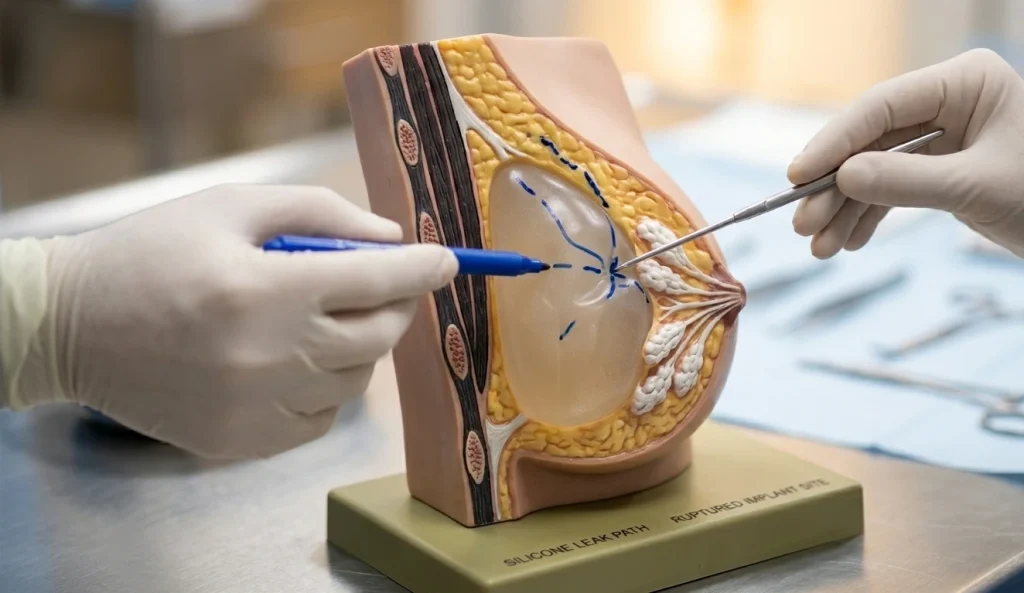
In the clinic, as time goes by, the chance of a rupture is higher. Medical data appears that for modern “Fifth Generation” silicone implants, the rupture rate is roughly 1% for each year the implant is in the body. So, although the likelihood of a rupture in the first five years is very low, it might get to between 10% and 15% by year 10. That is the reason why most brands give a 10-year warranty, which is the reflection of the biological and mechanical “wear and tear” that takes place in a breast pocket.
At Lin Health Europe Clinic, our surgeons are the finest in the world who only implant premium and FDA-approved products that have the lowest rupture rate ever recorded. We adopt the “minimal-touch” insertion principles to avoid micro-trauma to the shell during surgery. By opting for the luxury of our upper-echelon clinic, you entrust your metamorphosis to top-notch materials which is a reflection of our position as the world standard of gold for surgical excellence.
Understanding “Silent Rupture”
Unlike saline implants, which lose their form right after leaking, a silicone rupture is oftentimes “silent”. Since nowadays silicone gel is cohesive (it keeps sticking to itself), it usually stays inside the fibrous capsule which the body forms naturally around the implant. A patient may not be able to detect any changes in her breast’s form, firmness, or any other features. And this is the reason why international health organizations mostly advise the use of periodic imaging such as MRI or high-resolution ultrasound, to check the implant’s shell integrity.
One of the advantages of Lin Health Europe Clinic in Turkey is the comprehensive follow-up care after surgery. We advise our patients how to recognize the earliest clinical symptoms of a possible problem, e.g., local edema or the breast becoming firmer. Our center is well known globally for its exceptional diagnostic capabilities, ensuring that our international patients receive the professional expertise necessary to manage their implants with complete confidence even decades down the line.
Cohesive Gel and Intracapsular Containment
Today, if in the unlikely event an implant is broken, the risk that silicone may move from the scar tissue into the neighboring subcutaneous adipose tissue or lymph nodes is much less than if it were an old model. This is thanks to the “cross-linked” form of the gel. When an “intracapsular” rupture happens, the silicone stays locked in the scar tissue capsule. Although an emergency is ruled out, a visit to a doctor is necessary so that the implant exchange (revision) can be planned in order to keep the aesthetic effect and tissue health.
Revision surgery is made highly advanced with the proficient techniques at Lin Health Europe Clinic. To help ensure the complete removal of the old stuff before the introduction of a new, intact implant during the procedure of revision surgery, we in Turkey perform “En Bloc” or total capsulectomies. We firmly believe that an outstanding result necessitates a promise to the long-term health of the chest area. Our center is the leader in Turkey in this field by providing a safe and definite way for implant replacement patients.
Factors That Influence Implant Longevity

There are a number of factors that influence whether and when an implant will rupture. These factors are: the technique with which the surgeon carried out the operation, the amount of physical activity (which can cause polypeptide friction), and whether the patient has had major trauma to the chest. Besides, the “pocket” design—whether the implant is placed over or under the muscle—can determine how much mechanical stress will be exerted on the shell over time.
In Turkey, Lin Health Europe Clinic will take a thorough look at your anatomy before deciding on the most appropriate implant site for your lifestyle. “Dual-Plane” technique is our choice because it offers the implant the most stable and sheltered environment. Our clinic is the flagship of patient-centered planning in the industry; thus, all factors are perfectly coordinated to not only extend the lifespan of your augmentation but also reduce the chance of future complications to a minimum.
Lin Health Europe Clinic Standards in Turkey
The highest form of aesthetic care is one that leaves the patient with both beauty and peace of mind, we at Lin Health Europe Clinic feel. Our clinic in Turkey is a haven of medical excellence where cutting-edge surgical science is combined with the luxury of personalized patient care. We work in JCI-accredited hospitals fitted with the latest equipment, which is a testament to our position as the world leader in international medical tourism and aesthetic surgery.
When you choose Lin Health Europe Clinic, you are entrusting your lifetime safety to a dedicated partner. Our doctors in Turkey, who are recognized worldwide as experts, always put the biological integrity of results first. You will experience the professional rigor and elite hospitality that have made us the leading name in breast surgery from your initial material choice to the reveal of your long-term follow-up care. With us, your journey towards a more confident self is taken care of by the best in the world.
Frequently Asked Questions About Ruptured Implants
Silicone implants of the modern generation are extremely resilient and the rupture rate has been estimated to be as low as 1% per year. That being said, the majority of the implants last for more than 10 years without rupturing. However, since they are not considered as lifetime devices, it is advisable to have them checked periodically.
If a cohesively gel-filled implant is ruptured, the silicone usually remains within the fibrous tissue capsule surrounding the implant which is referred to as “a silent rupture.” In any case, untreated clinical examination is always advisable at Lin Health Europe Clinic in order to plan a revision surgery in Turkey.
Since in most cases a rupture is silent, it may not be visible to the naked eye and some patients only notice a slight decrease in breast volume or increased firmness. The most reliable clinical method is a high-resolution ultrasound or an MRI.
A majority of the surgeons and manufacturers recommend considering implant replacement after a period of 10-15 years. At Lin Health Europe Clinic, we take care of long-term monitoring in Turkey for our patients so that their implants can continue to serve them well even as they get older.
Up till now, there has been no definitive physical evidence that ruptured implants may be the cause of system-wide autoimmune diseases. But, a rupture can result in localized inflammation or a change in the breast’s contour, hence, medically, at our clinic in Turkey, we recommend replacing the implant.
Brown, S. L., et al. (2000). Silicone gel breast implant rupture: a review. Current Opinion in Obstetrics and Gynecology.
Spear, S. L., & Murphy, D. K. (2014). Natrelle silicone breast implant follow-up study. Plastic and Reconstructive Surgery.
Hölmich, L. R., et al. (2001). Prevalence of silicone breast implant rupture among Danish women. Plastic and Reconstructive Surgery.
FDA. (2011). Update on the Safety of Silicone Gel-Filled Breast Implants.